
 English


Views: 0 Author: Site Editor Publish Time: 2026-04-14 Origin: Site


What if the lowest price is not the best deal? That is often true when buying a Portable X-Ray system. Not all Portable X-Ray systems are the same. A compact battery-powered unit, a mobile DR cart, and a refurbished hospital system may all be called portable, but their cost and use are very different.
In this post, you will learn what affects Portable X-Ray pricing, how system types compare, and how to choose the right option for your application.
Before discussing price, it is important to define what a Portable X-Ray system actually is. In real-world sourcing, buyers often use “portable” and “mobile” interchangeably, but these categories can mean different equipment types.
The first category is the ultra-light or compact Portable X-Ray unit. This kind of system is typically designed for easy carrying, field use, home care, outreach work, or imaging in places where fixed power is limited. Current official product pages show that some portable systems are specifically designed to operate without direct electricity and can capture about 100 images on a full charge.
This type of Portable X-Ray solution is often associated with:
● compact generator design
● battery-powered operation
● easy transport
● flexible use in remote or temporary settings
● simple digital workflow with a wireless detector
For buyers, this category is attractive because it focuses on access and mobility more than on large integrated consoles or high-throughput bedside hospital workflow.
The second category is the mobile DR cart. This is still often marketed as a Portable X-Ray solution because it brings imaging to the patient, but it is much larger than an ultra-light unit. These systems are usually used in hospitals, wards, emergency departments, and ICUs. Current official product pages from major manufacturers emphasize bedside imaging, collapsible columns, lithium batteries, dual displays, and faster workflow around the patient.
A mobile Portable X-Ray cart system often includes:
● integrated workstation or display
● larger battery capacity
● motorized or assisted mobility
● stronger generator capability
● software tools for higher workflow environments
● better support for repeated bedside imaging
When hospital buyers ask about Portable X-Ray pricing, they are often thinking about this category rather than a hand-carried compact unit.
A third category is refurbished equipment. Refurbished Portable X-Ray systems may include older mobile DR carts or upgraded portable units that are still clinically useful but sold at a lower upfront cost. This segment is especially important because price guides show that refurbished systems are a major part of the market discussion for Portable X-Ray buyers.
The biggest reason to define Portable X-Ray first is that pricing depends on the type of system being discussed. A compact, battery-powered Portable X-Ray unit can have a very different cost structure from a hospital-grade mobile DR cart. Buyers who skip this step often end up comparing two products that solve very different workflow problems.
In simple terms:
Category | Typical Positioning | Main Use Scenario |
Lightweight Portable X-Ray unit | Compact, battery-powered, easy to carry | Remote imaging, home care, field use |
Mobile DR Portable X-Ray cart | Larger, integrated, bedside workflow | Hospital wards, ICU, ER, high-volume bedside imaging |
Refurbished Portable X-Ray system | Lower upfront cost, mixed form factors | Budget-focused buyers, replacement planning |
That is why any serious article about Portable X-Ray cost has to begin with product definition, not just price.
Now to the question buyers care about most: how much does a Portable X-Ray system cost?
The most practical answer is that the average cost depends on whether the system is refurbished, premium mobile DR, or a compact battery-powered design. One 2026 equipment price guide for refurbished systems places Portable X-Ray pricing at about $40,000 for basic units up to $100,000 for high-end models, with many intermediate systems falling around $60,000 to $75,000.
That does not mean every new Portable X-Ray system must fall in exactly the same range. It means that the publicly discussed market range for refurbished and installed hospital-grade portable/mobile systems already spans a very wide budget window.
A useful way to present the average cost is by buyer tier:
Price Tier | Typical Range | Typical Buyer Need |
Entry-level refurbished Portable X-Ray | $40,000–$45,000 | Small clinics, urgent care, low-volume workflow |
Intermediate refurbished Portable X-Ray | $45,000–$65,000 or roughly $55,000–$75,000 by model grouping | Imaging centers, smaller hospitals, moderate workflow |
Premium refurbished Portable X-Ray | $80,000–$95,000 | Hospital-grade workflow, integrated features, higher throughput |
New Portable X-Ray systems | Usually higher than refurbished, depending on design and configuration | Buyers prioritizing latest features, warranty, and current software[1] |
This kind of table is more useful than a single price statement because it shows buyers what the budget really buys.
The phrase “average cost of a Portable X-Ray system” can be misleading because two systems at similar prices may include different things. One quote may include:
● detector
● software
● cart
● battery package
● warranty
● installation
● training
Another quote may only include the base Portable X-Ray unit. That is why average price should always be treated as a starting point rather than a final answer.
A strong pricing article should also mention the hidden costs that affect the total cost of ownership. One current pricing guide specifically highlights additional costs such as service contracts, detector coverage, detector cases, and mobile wall stands.
In practice, the total investment in a Portable X-Ray system may include:
● service plan
● detector protection accessories
● spare batteries
● software upgrades
● wireless accessories
● mobile wall stand
● shipping and customs
● application training
● local regulatory compliance
So when buyers ask how much a Portable X-Ray system costs, the best answer is not just the machine price. It is the full budget required to make the system useful and sustainable.
Price differences in the Portable X-Ray market are not random. They reflect real differences in hardware, software, performance, mobility, and support.
Generator power is one of the biggest price drivers. A current price guide breaks refurbished Portable X-Ray systems into tiers that correlate with generator performance, from roughly 1.5–2 kW entry-level units to 12–30 kW intermediate systems and 15–40 kW premium systems.
More generator power usually means:
● broader clinical use
● higher exam capability
● faster workflow in demanding environments
● higher equipment cost
For many buyers, generator power is the line between a basic Portable X-Ray solution and a true hospital-grade mobile imaging system.
Detector choice has a major effect on Portable X-Ray cost. Some systems rely on retrofit panels or external detector workflows, while premium systems may include built-in, integrated detector support and stronger connectivity with PACS or mobile workflow tools.
A more advanced Portable X-Ray detector setup can influence:
● image quality
● exam speed
● dose efficiency
● workflow convenience
● overall system price
Battery design matters a lot in the Portable X-Ray category. Current official product pages highlight battery-powered imaging in environments without electricity and up to about 100 exposures on a full charge for some ultra-portable systems.
That kind of feature adds value because it expands where a Portable X-Ray system can be used:
● field deployment
● home care
● emergency outreach
● remote screening
● temporary imaging sites
In other words, buyers are not only paying for radiation generation. They are paying for mobility and independence from fixed infrastructure.
Modern Portable X-Ray systems increasingly compete on workflow. Current product pages highlight dual displays, tube-head controls, bedside image confirmation, collapsible columns, quiet drive performance, and faster in-room positioning.
These workflow features often increase system value because they reduce:
● exam delay
● staff movement
● positioning difficulty
● patient transport burden
● repeat exposures caused by workflow inefficiency
A lower-cost Portable X-Ray system may still take good images, but it may not offer the same speed and convenience.
Another price driver is image-processing intelligence. Current official product materials from large manufacturers explicitly highlight AI-based or AI-supported processing, improved dose control, virtual grid support, and advanced image enhancement.
For buyers, this matters because AI-enhanced Portable X-Ray workflow may support:
● better consistency
● faster review
● fewer processing errors
● clearer images in bedside settings
● lower repeat rates
These software capabilities can meaningfully raise the price of a Portable X-Ray system, but they can also improve return on investment.
A Portable X-Ray system that works in crowded hospital corridors, elevators, ICU rooms, and tight patient spaces needs strong mechanical design. Official product pages now emphasize clear line of sight, compact chassis design, low-noise operation, safety bumpers, and easier navigation in tight spaces.
Those mobility features are not cosmetic. They directly affect usability, especially in bedside imaging.
Serviceability also affects price. One current price guide emphasizes the importance of service options, detector coverage, and parts availability when buying Portable X-Ray equipment.
A cheaper Portable X-Ray system with weak support may cost more over time if downtime is frequent or parts are difficult to source.
One of the smartest ways to structure this topic is to compare new and refurbished Portable X-Ray systems side by side.
A new Portable X-Ray system is often the preferred choice for buyers who want:
● the latest workflow software
● current detector compatibility
● factory warranty
● stronger product image for new facilities
● future software or AI upgrade paths
● less concern about system age
New systems also follow current product trends more closely. Official pages from leading brands emphasize bedside workflow, AI-enhanced processing, lightweight design, smart charging, collapsible columns, and detector integration.
Refurbished Portable X-Ray systems appeal to budget-focused buyers. One 2026 guide states that refurbished systems typically cost 20%–40% less than new ones, while also offering faster availability in many cases.
That is why many facilities choose refurbished Portable X-Ray systems when they need:
● lower upfront cost
● faster replacement
● proven model familiarity
● more budget flexibility
● acceptable performance without newest features
Refurbished Portable X-Ray systems can be excellent values, but buyers should always ask about:
● detector status
● battery condition
● software version
● parts availability
● warranty coverage
● service response
● installed vs. as-is pricing
A good refurbished Portable X-Ray deal depends on transparency, not just price.
Factor | New Portable X-Ray | Refurbished Portable X-Ray |
Upfront cost | Higher | Lower |
Latest features | Stronger | Depends on model |
Availability | May involve lead time | Often faster |
Warranty | Usually broader | Varies by seller |
Upgrade path | Stronger | More limited |
ROI for tight budgets | Can be harder initially | Often attractive |
For many buyers, the right answer is not “new is better” or “refurbished is better.” The right answer is which type of Portable X-Ray best matches the facility’s budget and clinical demands.
A useful cost article should not stop at price. It should help the buyer connect the price to the actual application.
If the goal is bedside imaging in wards, ICU, NICU, or ER, a mobile DR Portable X-Ray cart is usually the stronger fit. Current product pages from major brands emphasize bedside workflow, patient-side controls, quiet operation, collapsible columns, and faster in-room image handling.
This type of Portable X-Ray is best when your priority is:
● bedside efficiency
● repeated daily use
● patient transport reduction
● hospital-level workflow
A more basic Portable X-Ray system may be enough for small clinics or urgent care settings. Current refurbished pricing guides even describe entry-level systems as suitable for single-doctor practices and lower daily patient volumes.
If the workload is limited, it may make more sense to choose a lower-cost Portable X-Ray rather than overbuy.
For outreach, home care, rural screening, or mobile services, ultra-light battery-powered Portable X-Ray systems are especially appealing. Official product pages show that some portable systems are designed specifically to work where no electricity is available.
This application favors:
● lightweight structure
● easy transport
● strong battery independence
● simple setup
The best Portable X-Ray system is not necessarily the cheapest or the newest. It is the one with features that actually support your workflow.
Modern Portable X-Ray products increasingly compete on size, chassis design, and ease of movement. Compact design matters in patient rooms, tight corridors, and emergency settings.
Battery performance is critical. A Portable X-Ray system with weak battery endurance may create workflow interruptions. Official product pages now promote stronger battery operation as a major advantage.
A modern Portable X-Ray setup should match detector options to the facility’s exam needs, budget, and dose requirements. Official mobile DR pages now emphasize broader detector choices for different facilities.
Two work zones, larger displays, and tube-head controls are becoming more important in hospital-grade Portable X-Ray systems because they support exam control without leaving the patient’s side.
A modern Portable X-Ray system increasingly includes or supports AI-enhanced imaging tools, advanced processing engines, virtual grid capability, or image-assistance software.
For mobile hospital use, a Portable X-Ray system should move smoothly and safely. Clear line of sight, low-noise movement, safety bumpers, and stable control features are no longer minor advantages; they are central buying points.
A buyer should also ask whether the Portable X-Ray system supports PACS connectivity, detector charging, workflow upgrades, and future software improvements. Current product trends suggest that future-proofing is becoming more important in this category.
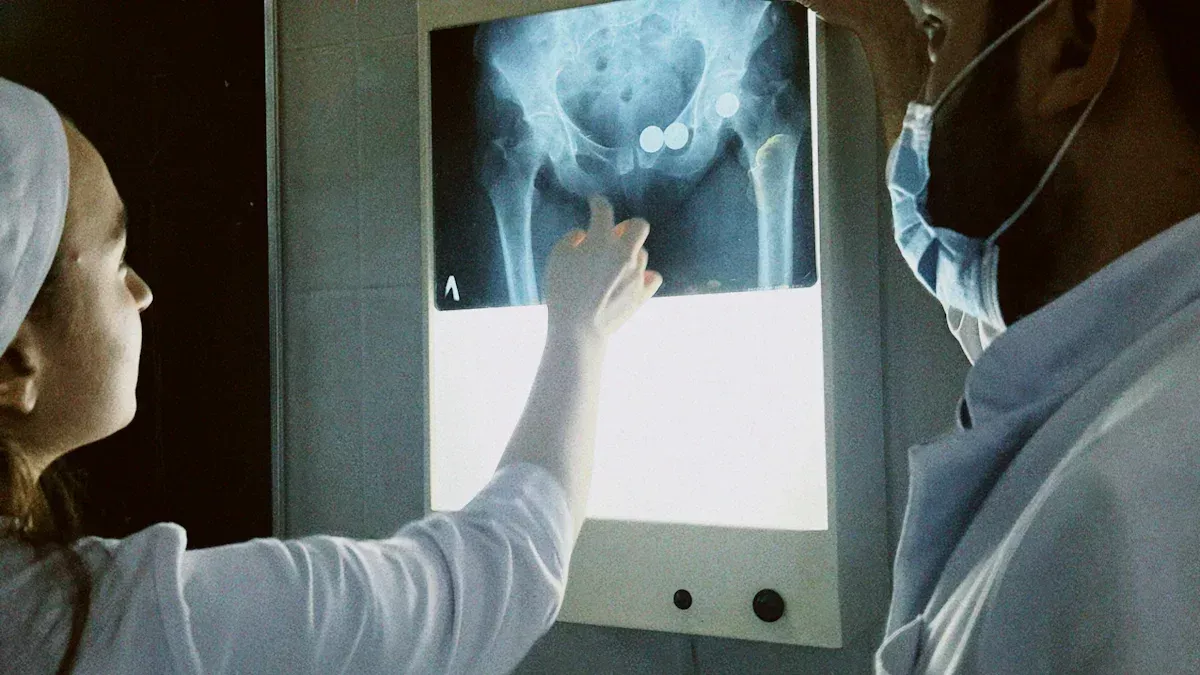
Buying directly from a Portable X-Ray manufacturer can offer important advantages, especially in B2B procurement.
A direct manufacturer can often tailor the Portable X-Ray system to your needs more clearly, including:
● generator level
● detector options
● software package
● battery configuration
● branding or OEM requests
● mobility format
When buyers purchase directly from a Portable X-Ray manufacturer, the quote is often easier to understand. You can separate the base unit, detector, accessories, service, and shipping more clearly.
For a Portable X-Ray project, direct technical answers matter. Buyers often need quick clarification on workflow, installation, detector compatibility, shipping size, and service planning.
A professional Portable X-Ray manufacturer should be able to support:
● product documentation
● training
● warranty
● replacement parts
● maintenance guidance
● product updates
This can make a major difference after the machine is delivered.
If you are a distributor, project buyer, or hospital group, working directly with a Portable X-Ray manufacturer can support long-term consistency in model planning, spare parts, and future orders.
So, how much does a Portable X-Ray system cost? The price depends on the system type, generator, detector, battery, software, and whether it is new or refurbished.
But the key question is not just the price. It is which Portable X-Ray system best fits your workflow, budget, and clinical needs. Some users need a compact unit for field use, while others need a mobile DR system for bedside imaging.
At Healicom Medical, we believe the best Portable X-Ray solution is the one that delivers the right balance of portability, image quality, and long-term value.
Refurbished Portable X-Ray systems commonly range from about $40,000 for entry-level units to around $100,000 for high-end models, with many mid-range systems falling around $60,000 to $75,000.
The price of a Portable X-Ray system changes based on generator power, detector type, battery design, mobility format, workflow features, software, AI tools, warranty, and whether it is new or refurbished.
In many cases, yes. A mobile DR cart often includes larger workflow hardware, stronger mobility features, and integrated displays, which can push the price higher than a simpler compact Portable X-Ray unit.
They can be. Current price guides note that refurbished Portable X-Ray systems often cost 20%–40% less than new ones, but buyers should check service, detector condition, and warranty carefully.


