
 English


Views: 0 Author: Site Editor Publish Time: 2026-11-16 Origin: Site


Selecting the right fluid delivery system stands as a critical procurement decision today. It directly impacts patient safety, regulatory compliance, and daily clinical operations. Facilities often struggle to balance high-volume delivery needs against micro-infusion precision requirements. Both systems share the overarching goal of controlled fluid delivery. However, their distinct mechanical architectures dictate fundamentally different use cases. They also create different error profiles and consumable supply chains. This guide breaks down the mechanical realities and consumable dependencies for both pump types. You will learn how to evaluate proprietary versus open systems. We also explore how to navigate complex regulatory frameworks safely. Clinical engineers and procurement teams can use these insights effectively. They will help you make evidence-based shortlisting decisions. Understanding these differences ensures your facility maintains high standards of care without compromising operational efficiency.
Mechanisms Dictate Volume: Syringe pumps excel in micro-infusion precision via stepper-motor plunger actuation, whereas a volumetric infusion pump utilizes peristaltic mechanisms for high-volume, continuous delivery.
Consumable Lock-in: The choice between closed-system proprietary tubing and open-system compatibility drastically alters the lifetime ROI of the equipment.
Risk and Compliance: Equipment failure and dosage errors are frequently linked to consumable mismatches, making FDA and MHRA compliance guidelines critical to the evaluation process.
Hybrid Environments: Most high-acuity facilities require a strategic mix of both technologies rather than a direct substitution.
The core of a volumetric infusion pump relies on linear or rotary peristaltic action. Linear mechanisms use finger-like projections. They compress IV tubing in a sequential wave pattern. Rotary mechanisms use rollers to achieve the same effect. Both methods mechanically compress standard or proprietary tubing. This continuous action moves fluid steadily toward the patient.
Their primary strength lies in high-volume delivery. These pumps effortlessly push fluids at rates up to 999 mL/hr. They are built for continuous, long-term infusions. Nurses rely on them for hydration protocols and prolonged nutritional support.
However, you must consider their mechanical limitations. They are susceptible to minor flow variations. Tubing elasticity degrades over time due to constant compression. This deformation causes slight inconsistencies in fluid volume over 72-hour periods. Therefore, they are not ideal for micro-dosing critical medications.
A syringe pump operates using a different mechanical principle. It utilizes a highly precise lead screw paired with a stepper motor. This motor continuously and smoothly drives the plunger of a loaded syringe. The linear motion pushes the exact required volume out of the barrel.
Its primary strength is unmatched accuracy at exceptionally low flow rates. They comfortably manage ranges from 0.1 mL/hr to 100 mL/hr. The hardware creates minimal dead space in the fluid path. Furthermore, the stepper motor ensures virtually no flow pulsation. This provides a steady serum concentration for the patient.
The mechanical limitations center around capacity. Volume is strictly capped by the maximum syringe size. You typically use 50mL or 60mL syringes. This constraint requires frequent manual interventions for larger infusions. Caregivers must pause delivery and physically swap syringes.
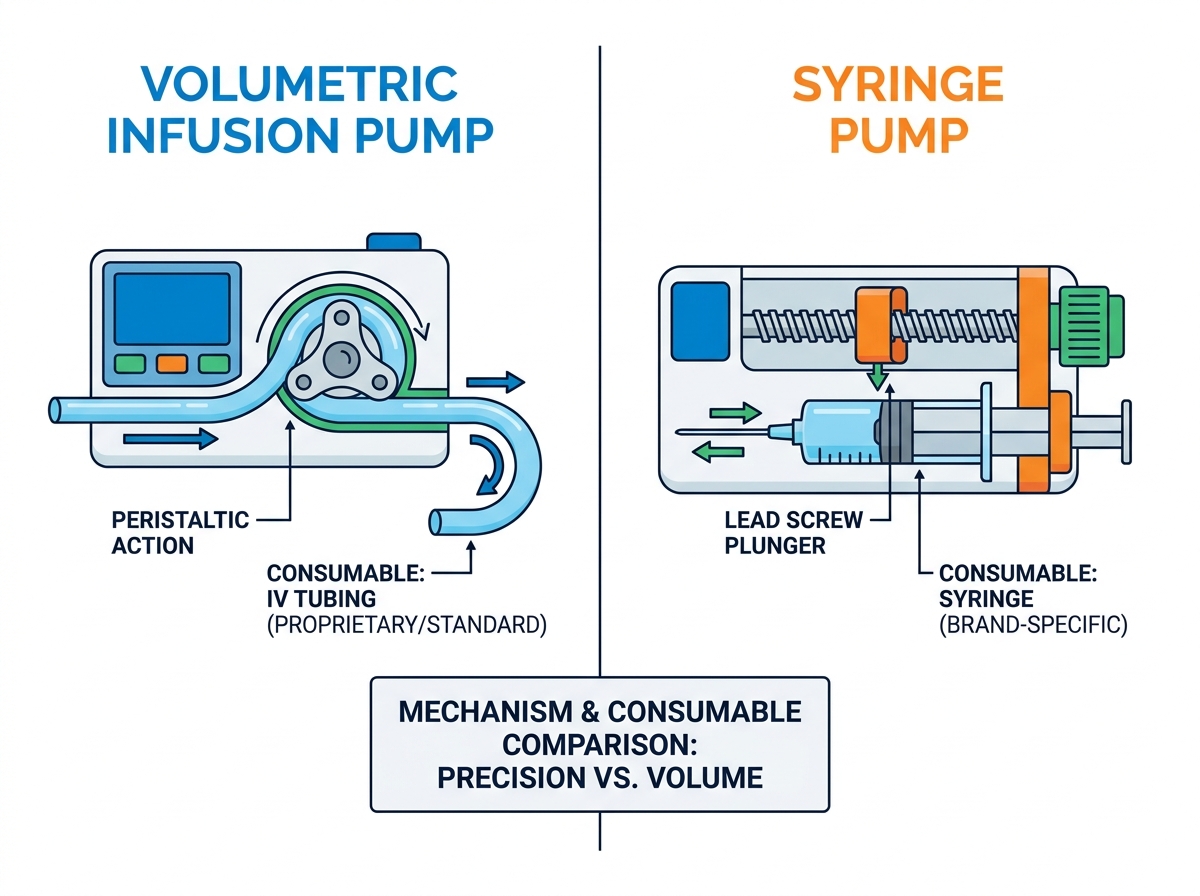
Facilities must choose between dedicated and standard IV sets. Proprietary IV sets guarantee accurate pump calibration out of the box. They typically feature built-in anti-free-flow valves. These specialized valves prevent accidental fluid dumping during tubing removal. However, proprietary systems significantly increase ongoing operational costs. You become locked into a single vendor for supplies.
Tubing integrity risks remain a crucial consideration. Substandard or mismatched tubing degrades quickly under peristaltic pressure. This degradation leads to frequent occlusion alarms. It also causes inaccurate volume delivery. Regulatory incident reports frequently cite tubing mismatches as a focal point for adverse events.
Brand calibration requirements are rigid for syringe mechanics. You must explicitly calibrate the pump to a specific syringe brand and size. Common brands include BD, Terumo, and B. Braun. The pump software relies on these exact physical dimensions. If the barrel width varies slightly, the delivery algorithm will miscalculate the dose.
Open system advantages offer a compelling alternative. Some modern platforms allow clinical engineers to calibrate and save custom syringe profiles. This flexibility offers superior supply chain resilience. When global shortages impact a specific brand, open systems allow you to pivot seamlessly.
Modeling long-term hardware value requires analyzing operational expenditure ratios. You must compare initial capital expenditure against ongoing consumable requirements over a five-year lifecycle. Closed systems mandate high-volume purchasing of specialized sets. Open systems provide negotiation leverage across multiple consumable vendors. Evaluating infusion and syringe pumps holistically prevents unexpected operational budget overruns.
Table: Consumable System Characteristics
System Type | Primary Benefit | Supply Chain Risk | Ideal Use Case |
|---|---|---|---|
Proprietary Tubing | Guaranteed flow accuracy | High (Vendor lock-in) | High-risk infusions needing anti-free-flow valves |
Standard Open Tubing | Cost efficiency | Low (Multiple suppliers) | General hydration and ward use |
Brand-Specific Syringes | Precise mechanical fit | Moderate (Brand shortages) | Neonatal and critical care micro-dosing |
Custom Profile Syringes | Maximum flexibility | Low (Highly adaptable) | Facilities facing frequent supply disruptions |
Volumetric designs excel in specific therapeutic environments. They are the gold standard for Parenteral Nutrition (TPN) and large-volume hydration. You should also deploy them for standard intravenous antibiotics. General ward use is their primary domain. In these settings, flow rate accuracy requirements comfortably tolerate a ±5% margin of error.
High-acuity scenarios demand a different approach. Neonatal and pediatric care units rely heavily on plunger-driven systems. In these populations, fluid overload represents a critical, life-threatening risk. Furthermore, they are essential for Target Controlled Infusion (TCI) during anesthesia. Intensive Care Units use them for vasoactive drug delivery. Veterinary clinics also require them for precise micro-dosing in small animal care.
Outpatient care introduces mobility into the clinical equation. The role of the portable syringe pump continues to expand rapidly. They are indispensable for pain management and palliative care. They also facilitate continuous subcutaneous infusions. In these scenarios, patient mobility is paramount. Caregivers need lightweight hardware that maintains strict delivery parameters without tethering the patient to a wall socket.
Regulatory bodies categorize infusion devices strictly based on risk profiles. The FDA and MHRA continuously monitor field performance data. Device recalls are disproportionately tied to software errors. They also frequently stem from occlusion sensor failures. Unauthorized consumable use remains a leading cause of preventable harm. Facilities must align procurement choices with these regulatory guidelines.
Pressure management differs fundamentally between the two technologies. Volumetric hardware typically measures inline pressure within the tubing. Conversely, syringe systems detect resistance directly against the pusher block. You must ensure your equipment features adjustable occlusion thresholds. If pressure builds up against a blockage, high thresholds can cause fluid pooling in the line. Once cleared, this pooling can result in a dangerous bolus release post-occlusion.
Routine metrology checks define safe clinical practice. Hospitals must verify flow accuracy using standardized testing equipment. Substituting unapproved, cheaper consumables is a dangerous practice. It voids manufacturer accuracy guarantees immediately. More importantly, it transfers severe legal liability directly to the healthcare provider. Strict adherence to validated consumables ensures optimal safety.
A rigorous needs assessment prevents costly procurement mistakes. You must audit your current clinical bottlenecks before requesting vendor proposals. Consider the following workflow evaluation steps:
Audit nursing workflows to see if staff frequently change 50mL syringes for therapies better suited to higher-volume delivery.
Evaluate the existing consumable supply chain constraints.
Identify if the facility already has standardized contracts for specific IV sets.
Determine the required ratio of micro-dosing units to high-volume hydration units.
Hardware performance tells only half the story. You must assess integration capabilities thoroughly. Determine if the equipment supports Dose Error Reduction Systems (DERS). Evaluate the compatibility of smart pump drug libraries. Ensure seamless Electronic Medical Record (EMR) connectivity to automate documentation. Additionally, evaluate battery life and casing durability for frequent inter-departmental transport scenarios.
Procurement teams must build a transparent decision matrix. You should balance upfront hardware discounts against the reality of long-term proprietary tubing contracts. Avoid vendors who obscure the per-unit cost of mandatory consumables. Insist on clear, guaranteed pricing for operational supplies over the entire expected life of the equipment.
Neither pump architecture is universally superior. Their true value is dictated by the precise matching of mechanical capability to clinical intent. High-volume hydration fundamentally requires different hardware than neonatal vasoactive therapy. Procurement teams must align their hardware purchases with their consumable purchasing power. You must also account for the specific acuity levels of your patient or veterinary populations.
Ensure your facility maintains a strategic mix of delivery technologies. Avoid over-standardizing on a single platform if it compromises specialized clinical needs. We recommend prompting your supply chain partners for deeper transparency. Request a localized operational efficiency analysis today. Access a pump-to-tubing compatibility matrix, or schedule a technical demonstration with a product specialist to validate your assumptions.
A: It is generally not recommended. Volumetric pumps have a higher margin of error at very low flow rates compared to syringe pumps. This mechanical limitation increases the risk of under-dosing or over-dosing critical medications. Plunger-driven systems provide the required precision for these scenarios.
A: An open system allows the pump to accurately operate using standard, commercially available consumables. This includes various brands of syringes or standard IV lines. It prevents restricting the user to a single manufacturer's proprietary products, offering better supply chain flexibility.
A: This often occurs if the pump is calibrated for a different brand of syringe than the one loaded. It causes a physical mismatch in the drive mechanism. It can also happen if the occlusion pressure threshold is set too low for the viscosity of the fluid.
A: High-quality portable models maintain rigorous accuracy standards. However, buyers must verify that the specific model is FDA-cleared or CE-marked for the intended clinical application. Some ambulatory models prioritize battery life and physical size over extreme micro-infusion precision.


