
 English


Views: 0 Author: Site Editor Publish Time: 2026-11-06 Origin: Site


Transitioning from a medical prescription to purchasing the right hardware often leaves buyers completely confused. Doctors prescribe a precise Liters Per Minute (LPM) target for respiratory therapies. However, matching this prescription to a physical machine requires careful attention to technical details. Buyers frequently misinterpret maximum flow rates. They often fail to realize how pushing a machine to its limit impacts actual delivered oxygen concentration.
The core issue lies in the marketplace itself. Consumer-grade machines frequently sacrifice oxygen purity just to boast higher flow numbers. Meanwhile, medical-grade devices must maintain strict clinical thresholds to keep patients safe. This article delivers a comprehensive clinical and technical breakdown of specification sheets. We will show you exactly how to evaluate stationary concentrator units. You will learn how to avoid costly mispurchases while perfectly aligning machine capabilities to your exact medical requirements.
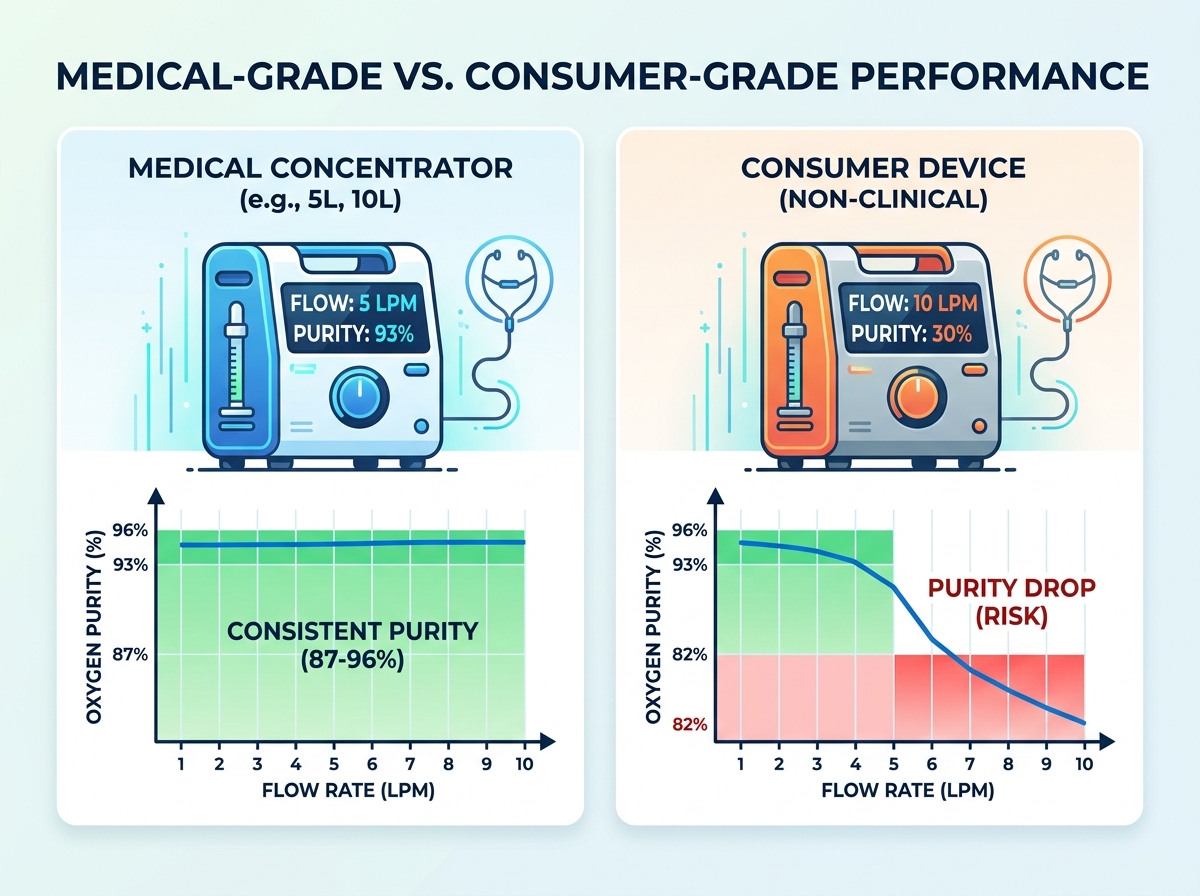
Medical-grade concentrators must maintain 87% to 96% oxygen purity across their *entire* flow range; a drop in purity at maximum flow indicates a non-compliant or consumer-grade device.
A 5L machine is the industry standard for general oxygen therapy, balancing power consumption, noise, and weight for prescriptions up to 4 LPM.
Upgrading from a 5L to 10L oxygen concentrator is necessary for high-acuity needs, long tubing runs, or CPAP/BiPAP integration, but introduces significant physical and electrical footprints.
Purchasing a machine with a higher capacity than prescribed (e.g., using a 10L machine for a 2L prescription) does not deliver "better" oxygen, but can provide overhead for progressive respiratory conditions.
Before purchasing respiratory equipment, you must understand two foundational metrics. These numbers dictate whether a machine can effectively support your respiratory health.
First, we define Flow Rate (LPM). This represents the volume of gas delivered per minute. Second, we look at Oxygen Purity (%). This denotes the percentage of the delivered gas containing pure oxygen. Standard room air holds roughly 21% oxygen. A medical device must significantly elevate this concentration.
Concentrators achieve this purification using specialized internal components called zeolite sieve beds. Room air enters the machine through a series of filters. The compressor pushes this air into the sieve beds under high pressure. Zeolite materials act as a molecular sponge. They naturally scrub nitrogen out of the ambient air. The machine then expels the nitrogen back into the room. It sends the remaining highly concentrated oxygen directly to the patient.
A widespread deception plagues the online marketplace today. Many cheap, imported machines heavily advertise a "10L flow" capacity. Buyers see this number and assume they are getting a powerful medical device. However, these consumer-grade machines harbor a dangerous flaw. When turned up to their maximum output, their internal sieve beds become overwhelmed. The nitrogen-scrubbing process fails to keep pace with the high air volume.
As a result, the oxygen purity drops drastically. Some of these devices plummet to a mere 30% oxygen purity at higher flow settings. This renders them medically useless for anyone requiring supplemental oxygen therapy.
You can protect yourself by following a strict baseline rule. Legitimate medical oxygen concentrator systems will feature an Oxygen Percentage Indicator (OPI). This critical sensor actively monitors the delivered gas mix. If purity falls below 82%, the machine triggers an audible and visual alarm. It does this regardless of the selected flow rate. If a specification sheet lacks an OPI feature, you should avoid purchasing it for clinical use.
Table: Medical vs. Consumer Grade Output Behavior
Device Category | Purity at 2 LPM | Purity at Max Flow | OPI Alarm Included? | Clinical Viability |
|---|---|---|---|---|
Medical-Grade (FDA/Medicare compliant) | 87% - 96% | 87% - 96% | Yes (Alarms below 82%) | High (Safe for 24/7 use) |
Consumer-Grade (Non-compliant) | 90% | 30% - 40% | No | None (Recreational only) |
For most patients beginning oxygen therapy, the 5-liter machine represents the industry standard. It offers an excellent balance of performance and daily practicality.
Doctors typically prescribe oxygen delivery anywhere between 1 and 4 LPM for general respiratory maintenance. A standard 5L stationary unit handles this workload perfectly. Because the prescription sits below the machine's maximum limit, the internal compressor operates efficiently. It maintains optimal pressure and consistent purity.
These devices are engineered for continuous endurance. They are fully capable of running 24 hours a day, 7 days a week. Furthermore, they suffer minimal pressure drops when paired with standard 25-foot nasal cannulas. This allows patients reasonable mobility around a living room or bedroom.
While highly capable, bringing a 5L unit into your home requires some logistical planning. You must account for several physical factors.
Weight & Footprint: Most modern 5L units weigh between 30 and 40 pounds. Manufacturers mount them on built-in casters. This makes them relatively easy to roll between rooms over hard floors or low-pile carpets.
Power Consumption: A typical 5L model draws an average of 280W to 350W of electricity. You can think of this as roughly equivalent to running a high-end desktop computer continuously.
Noise Levels: These units represent the quietest class of stationary concentrators. Operating volumes range from 40 to 48 decibels. This hum is comparable to a quiet refrigerator. It rarely disrupts sleep or normal conversation.
Some medical situations exceed the physical limits of standard equipment. In these cases, upgrading your primary unit to a 5L to 10L oxygen concentrator becomes necessary. High-flow machines serve distinct clinical purposes.
You generally need a high-flow machine under three specific medical or environmental conditions. Your doctor or respiratory therapist will usually flag these requirements early on.
First, high-acuity respiratory conditions demand greater support. Severe Chronic Obstructive Pulmonary Disease (COPD), advanced pulmonary fibrosis, or cluster headache management often require 5 or more liters per minute continuously. A 5L machine maxes out at this threshold, offering no safety buffer. A 10L machine comfortably provides the required volume while maintaining strict purity levels.
Second, CPAP or BiPAP integration frequently necessitates high-flow capacities. Sleep apnea patients who also need oxygen use "bleed-in" systems. The oxygen routes directly into the pressurized CPAP circuit. Because the CPAP pushes high volumes of room air, it naturally dilutes the incoming oxygen. You need a continuous, robust high flow to maintain the proper oxygen mixture inside the mask.
Third, extended tubing runs demand higher internal compressor pressure. Many patients attach 50-foot tubing to navigate large homes freely. Long hoses create natural resistance and friction. This causes a significant pressure drop at the nasal cannula. A 10L compressor pushes hard enough to overcome this resistance, delivering accurate volumes at the end of a long line.
High-flow capacities do not come without compromises. Moving from 5 liters to 10 liters drastically alters the machine's physical characteristics.
Compressor Size: Processing double the air volume requires a significantly larger internal compressor. This pushes the total weight of 8L and 10L machines up to 50 or even 60-plus pounds. They are much harder to lift over thresholds or transport in vehicles.
Thermal Output: High-flow machines generate noticeable ambient heat. The rigorous nitrogen-scrubbing process creates friction and thermal exhaust. If you place a 10L unit in a small, closed bedroom, you will definitely notice the room temperature rise over a few hours.
Bringing heavy medical hardware into a residential space forces you to confront infrastructure limits. You must plan for electrical and environmental impacts before unboxing your device.
Electrical draw often surprises new users. A 10L machine working at full capacity can pull 600W or more. A significant risk factor emerges here. Running these heavy-duty machines on shared household circuits can trip circuit breakers. Older residential bedroom wiring is particularly vulnerable.
If you plug a 10L unit into the same circuit as a window air conditioner or space heater, the breaker will likely fail. We highly recommend mapping your home circuits. Dedicate a specific, unshared wall outlet to your concentrator to ensure uninterrupted therapy.
Larger compressors create louder environments. High-flow machines typically operate at 50 or more decibels. This level of constant mechanical humming can easily disrupt light sleepers.
You can employ practical workarounds to manage this noise. Many patients utilize 50-foot tubing extensions. This allows you to place the loud unit in a separate, well-ventilated room down the hallway. Keep the noisy hardware away from the sleeping area. However, always follow manufacturer guidelines regarding absolute maximum tubing lengths. Exceeding them will trigger pressure alarms and compromise your treatment.
Always check for regulatory compliance. Ensuring your device meets FDA standards serves as a vital baseline check for legitimacy. Medical-grade stationary units typically qualify for Medicare HCPCS code E1390. If a retailer cannot confirm this coding or FDA registration, you are likely looking at a recreational device. Do not trust your respiratory health to unregulated hardware.
Selecting the exact right machine requires matching your doctor's orders to physical hardware capabilities. Use this structured approach to finalize your purchase confidently.
Match the Prescription, Plan for the Prognosis: Consult your respiratory therapist about the trajectory of your condition. If your respiratory health is stable, a 5L unit easily suffices for low prescriptions. However, if your condition is progressive, investing in an 8L or 10L unit provides crucial "room to grow." You will not have to buy a completely new machine a year later.
Verify the OPI and Purity Spec Sheet: Look past the marketing headlines. Dig into the technical manual. Never buy a machine without verifying the "Purity at Max Flow" specification. The documentation must clearly state the machine delivers 87% to 96% purity at its highest liter setting. Furthermore, explicitly confirm the presence of an OPI alarm system.
Assess the Household Infrastructure: Run a quick home checklist. Do you have an available, grounded electrical outlet on a relatively unburdened circuit? Does the chosen room offer adequate ventilation to prevent the compressor from overheating? Do you have enough clear floor space to keep the machine at least 12 inches away from walls and curtains? Answering these questions prevents dangerous setup mistakes.
Navigating the technical specifications of respiratory equipment does not have to be overwhelming. Keep the fundamental rule in mind: Flow rate determines the sheer volume of air delivered, while the machine's clinical grade guarantees the actual oxygen purity. You cannot trade one for the other without jeopardizing your health.
Buying a stationary concentrator represents a major infrastructural medical decision. Always prioritize safety mechanisms over superficial marketing claims. Look for verified OPI alarms, proper compressor sizing, and strict compliance with medical standards. Protect your investment and your well-being by choosing hardware designed for clinical endurance.
Your next step is clear. Review your exact prescription parameters with your healthcare provider. Then, verify the electrical capacity and physical space of the room where you plan to station the unit. Doing this prep work today ensures a seamless, safe transition to your new oxygen therapy routine.
A: Yes, most 10L machines can be safely dialed down to a 2L output. However, using a larger machine for a small prescription means it will consume more electricity, generate more ambient heat, and create significantly more noise than a standard 5L machine performing the exact same job.
A: Excessive tubing lengths, tight coils, or unexpected kinks create severe back-pressure in the line. This resistance disrupts the internal compressor and sieve beds, temporarily lowering the oxygen purity. Always check your manufacturer's specific limits on total tubing length to avoid triggering these alarms.
A: No. Portable Oxygen Concentrators (POCs) generally max out at 3L for continuous flow due to strict battery and compact compressor size limitations. If you see higher numbers on a POC, these almost always refer to "pulse dose" settings, not true continuous liters per minute.


