
 English


Views: 0 Author: Site Editor Publish Time: 2026-11-16 Origin: Site


Sterile Processing Departments (SPDs) and clinical facilities face a constant balancing act. They must maximize sterilization throughput while protecting expensive, delicate surgical inventories. The pressure to maintain operational tempo never stops. Traditional sterilization degrades complex modern medical devices rapidly. This drives up repair and replacement rates across the facility. Conversely, alternative methods can introduce throughput bottlenecks or create heavy operational overhead. Making the choice between hydrogen peroxide plasma vs steam sterilization is not a simple either/or scenario. You must strategically allocate equipment based on material compatibility, safety guidelines, and infrastructure compliance.
This guide provides an evidence-based evaluation framework. We will help procurement and facility leaders match the right sterilization modality to their specific demands. You will learn the core mechanisms behind these technologies. We will outline strict material incompatibilities and facility infrastructure impacts to inform your next equipment acquisition.
Steam sterilization remains the gold standard for durable, heat-resistant instruments due to its low cost per cycle, high throughput, and robust penetration.
An H2O2 plasma sterilizer is essential for temperature-sensitive medical instruments, extending the lifespan of expensive endoscopes, cameras, and delicate polymers.
Material compatibility dictates the primary divide: steam degrades complex plastics and electronics, while H2O2 plasma is strictly incompatible with cellulose, linens, and certain dead-end lumens.
Total Cost of Ownership (TCO) must factor in not just equipment and consumables, but the verifiable ROI of reduced instrument wear and tear over a 5-to-10-year lifecycle.
Steam sterilization relies on foundational thermodynamic principles. A steam autoclave uses saturated steam under immense pressure to achieve exceptionally high temperatures. Cycles typically run between 121°C to 132°C (250°F to 270°F). The pressurized moisture transfers thermal energy rapidly into the load. This intense heat permanently denatures microbial proteins. It destroys bacteria, viruses, and tough bacterial spores instantly.
The operational reality of steam is demanding but highly efficient. Large-scale units rely heavily on dedicated facility plumbing. They require specialized boilers and robust ventilation systems. Despite the heavy infrastructure footprint, steam remains unmatched in pure efficacy. It penetrates dense surgical trays easily. Most importantly, the process leaves zero toxic residue behind.
Always verify steam quality to prevent wet packs.
Load trays loosely to ensure steam can penetrate every crevice.
Perform daily Bowie-Dick tests to confirm proper air removal.
Modern surgical instruments often cannot survive extreme heat. This is where a low temperature sterilizer becomes mandatory. These systems typically operate between 45°C to 50°C. The machine injects liquid hydrogen peroxide into a deep vacuum chamber. It vaporizes the liquid into a gas. The system then applies an intense electrical field to the vapor. This energy shears the molecules apart, creating a highly reactive plasma state. Free radicals bombard the microorganisms. They destroy microbial DNA and RNA completely.
The operational reality of plasma is highly flexible. These units often function as plug-and-play solutions. They usually require only standard electrical outlets. They require no complex plumbing or external ventilation. The plasma safely breaks down into simple water vapor and oxygen at the end of the cycle. This guarantees immediate safety for the operator.
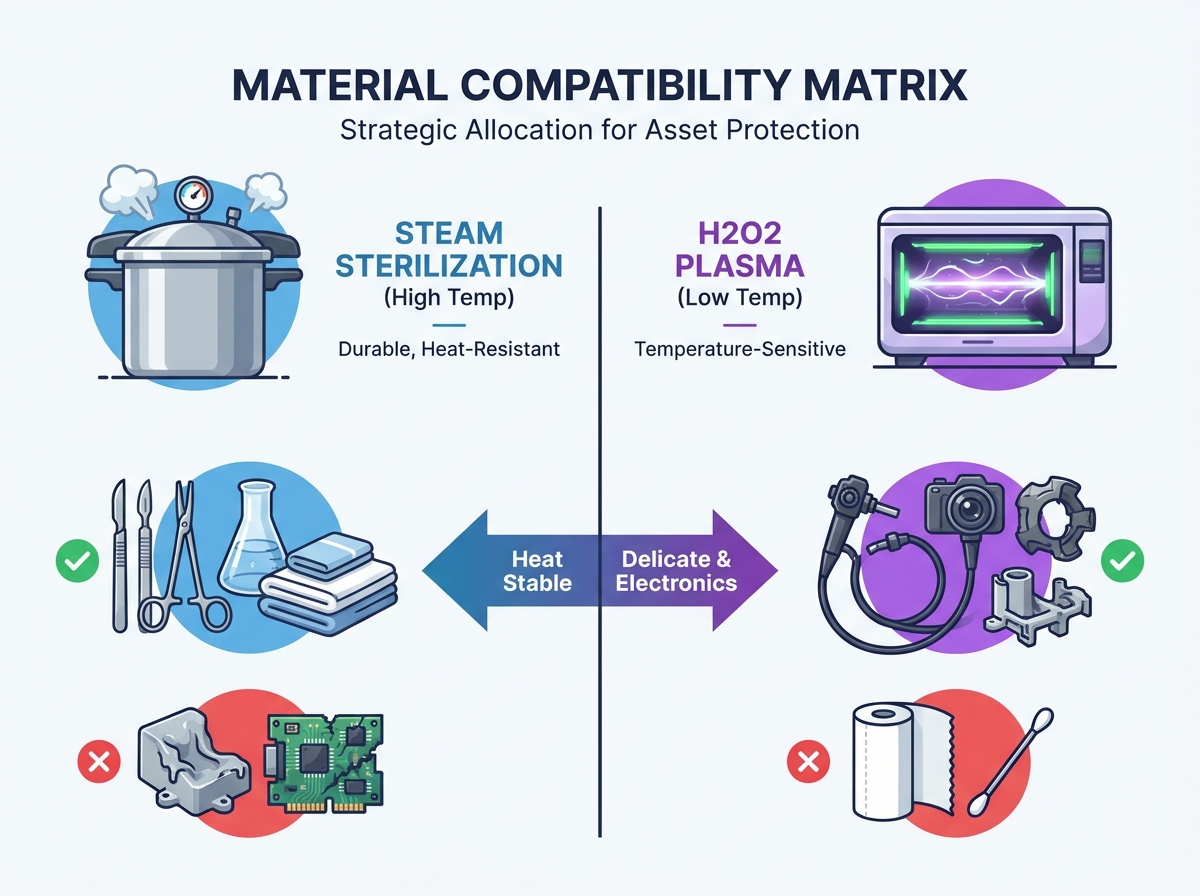
Making the wrong compatibility choice guarantees catastrophic equipment failure. You must categorize your inventory strictly. Every surgical tray must align perfectly with the sterilizer's physical limitations.
Steam thrives on durability. Stainless steel surgical instruments welcome steam cycles. Scalpels, forceps, retractors, and heavy orthopedic clamps belong here. Heat-stable glassware survives the thermal shock easily. Heavy-duty, durable rubbers also withstand the pressure without degrading. Traditional textiles rely entirely on steam. You can confidently process linens, cotton towels, and cellulose-based surgical wrappers in a standard autoclave.
Modern medicine relies on advanced optics and delicate sensors. You must use plasma for temperature-sensitive medical instruments. Rigid and flexible endoscopes demand gentle processing. Camera heads and delicate fiber optics will shatter or delaminate under high heat. Medical plastics, polycarbonates, and polyurethanes maintain their structural integrity in plasma. Moisture-sensitive electronic components and surgical batteries require this exact technology to avoid short circuits.
You must actively prevent cross-contamination of methods. Operators make common mistakes by ignoring fundamental material chemistry.
Do not use H2O2 for: Cellulose materials. Paper, cotton, and linens absorb the vaporized sterilant heavily. The machine detects the pressure drop and aborts the cycle automatically. Additionally, plasma struggles with very long, narrow dead-end lumens. It cannot push the charged particles deep into unvalidated tubes.
Do not use Steam for: Low-melting-point plastics. Precision medical optics face a massive risk of lens delamination. Unsealed electronics will trap pressurized moisture, destroying the circuitry permanently.
Table 1: Sterilization Compatibility Matrix Summary
Material / Instrument Type | Steam Autoclave Compatibility | H2O2 Plasma Compatibility |
|---|---|---|
Stainless Steel Instruments | Excellent | Good (but often unnecessary) |
Cotton, Linens, Cellulose | Excellent | Strictly Incompatible |
Flexible Endoscopes | Strictly Incompatible | Excellent |
Medical Batteries & Electronics | Strictly Incompatible | Excellent |
Standard Paper Pouches | Excellent | Strictly Incompatible |
Integrating new sterilization technology reshapes your department's physical footprint. You must look beyond simple specifications. Infrastructure demands and daily throughput define true operational efficiency.
Steam systems impose heavy facility requirements. Installing a bulk sterilizer often requires breaking concrete. You must run specialized, high-pressure steam lines. You need dedicated water softening systems to prevent boiler scale. This creates massive installation friction for older facilities.
Plasma units remove this friction entirely. They require minimal structural intervention. You roll them into place and plug them in. However, they rely on proprietary chemical cassettes and specialized cups. This creates a steady dependency on specific supply chains. You trade heavy structural demands for consistent inventory management.
Both methods excel at keeping the Operating Room (OR) supplied. Cycle speeds dictate your daily surgical volume. Steam provides rapid turnaround for heavy, dense bone-trays. Plasma provides equally fast turnarounds for delicate optics. You typically see cycles ranging from 25 to 75 minutes. This depends strictly on the load weight and the selected cycle type.
These rapid turnarounds provide a massive advantage over older alternatives. Ethylene Oxide (EtO) requires lengthy, disruptive aeration periods. EtO can lock up an instrument for 12 to 24 hours. Plasma puts the instrument back into rotation within an hour.
Aggressive heat accelerates wear and tear. Constant thermal expansion and contraction degrade hinges and joints. Switching delicate items to plasma preserves high-value surgical assets. Gently processing a $10,000 endoscope extends its operational lifespan drastically. You reduce the frequency of external repairs. You keep critical diagnostic tools in the hands of surgeons rather than on a repair bench.
Both modalities meet strict CDC guidelines for sterilization efficacy in healthcare facilities. They achieve the required Sterility Assurance Level (SAL) of 10^-6. However, regulatory compliance hinges on one critical rule: you must follow the device manufacturer's validated Instructions for Use (IFU). If a manufacturer specifies plasma, placing that item in steam violates compliance protocols immediately.
Technician safety remains a top priority for facility managers. Older low-temperature methods like EtO pose severe carcinogenic risks. They demand strict environmental monitoring and toxic off-gassing management. Plasma eliminates these hazards entirely. The hydrogen peroxide breaks down safely into water and oxygen. It ensures immediate occupational safety for all SPD personnel without requiring hazardous material suits or specialized exhaust hoods.
You cannot use the same packaging for both machines. ISO 11607 dictates strict standards for sterile barrier systems. Your packaging must allow the sterilant to penetrate while maintaining the sterile boundary post-cycle.
Steam Packaging: Highly versatile. You can use standard woven wrappers. Non-woven blue wraps work perfectly. Traditional paper and plastic peel pouches handle the heat and moisture easily.
H2O2 Plasma Packaging: Highly restrictive. You must use specific synthetic packaging. Tyvek® pouches are mandatory because they utilize high-density polyethylene. This allows the plasma vapor to pass without absorbing it. Validated rigid containers with specific synthetic filters also work well. Standard paper pouches will absorb the peroxide and cause immediate cycle failures.
Building a resilient sterile processing department requires careful planning. You cannot guess your equipment needs. You must analyze your surgical data and facility constraints systematically.
Start by analyzing your instrument trays. Group your facility's inventory strictly by IFU requirements. Calculate the daily volume of heat-sensitive loads versus heat-resistant loads. Look closely at your orthopedic, neurology, and endoscopy schedules. This data reveals your actual capacity requirements.
Determine your current plumbing, boiler, and HVAC capabilities. Walk the floor with your facility engineers. Older hospitals may find installing a new plasma unit much easier. Retrofitting high-pressure steam lines into a 40-year-old basement causes massive disruption. Map out your electrical panels to ensure you can support new standalone units.
Modern SPDs cannot rely on a single modality. Surgery is too diverse. A balanced fleet is the recognized industry standard. You need high-capacity bulk steam autoclave units to anchor the department. They handle the massive volume of basic trays. You support them with agile H2O2 plasma sterilizer units dedicated to specialized instrumentation. This hybrid model prevents bottlenecks.
Do not accept vague promises from equipment vendors. Demand rigorous data before purchasing. Request specific lumen claim validations. If you process long, narrow robotic arms, the vendor must prove their machine can penetrate them. Ask for detailed consumable availability guarantees. Secure comprehensive preventative maintenance Service Level Agreements (SLAs) to guarantee maximum uptime.
The choice between hydrogen peroxide plasma and steam is dictated heavily by your facility's case mix. You must base your strategy on the physical realities of your instrument inventory. Do not view these technologies as competitors. View them as complementary tools within a comprehensive infection control strategy.
Steam remains the undisputed workhorse for bulk, durable goods. Its pure mechanical efficiency processes massive volumes seamlessly. However, surgical interventions continue shifting toward minimally invasive techniques. They rely entirely on complex, temperature-sensitive electronics and delicate optics. Integrating plasma sterilization is no longer an optional luxury. It is a critical requirement for asset protection. It guarantees continuous clinical operation and elevated patient safety.
A: Yes, stainless steel is highly compatible with H2O2 plasma. However, it is rarely efficient to do so unless the stainless steel is part of a mixed-material, temperature-sensitive device. Processing basic stainless tools in plasma consumes expensive synthetic pouches and proprietary sterilant unnecessarily.
A: Cycles typically range from 24 to 75 minutes. This depends on the specific machine model, the load weight, and the presence of complex lumens. This offers comparable turnaround times to traditional steam cycles, keeping surgical schedules running smoothly.
A: Cellulose-based materials act like a sponge. They absorb the vaporized hydrogen peroxide rapidly. This prevents the sterilant from reaching the necessary concentration to form a plasma state. The machine sensors detect this pressure drop, resulting in an automatic cycle abort.
A: For operators and the environment, yes. H2O2 breaks down safely into simple water and oxygen. It requires no dangerous aeration time. It completely eliminates the toxic off-gassing and carcinogenic exposure risks historically associated with EtO gas.


