
 English


Views: 0 Author: Site Editor Publish Time: 2026-11-20 Origin: Site


Safely moving critically ill, mechanically ventilated patients presents severe physiological risks. Inter-hospital transfers and intra-hospital transports expose vulnerable individuals to highly fluctuating environments. The fundamental challenge for procurement and clinical teams is clear. You must maintain uninterrupted, high-level respiratory support in severely resource-constrained settings.
Modern high-end transport devices blur traditional lines. They offer highly advanced breathing modes. However, dedicated stationary units remain the undisputed gold standard for long-term care. Choosing between these options requires a rigorous evaluation. You must carefully analyze hardware limitations, power requirements, and infrastructure dependencies.
This article provides an evidence-based framework for evaluating these devices. We designed this guide for clinical engineers and respiratory directors. You will learn to compare hardware tradeoffs between stationary and portable units. We focus extensively on power autonomy, pneumatic efficiency, and monitoring continuity. By understanding these technical nuances, you can ensure safer patient transport without compromising the standard of care.
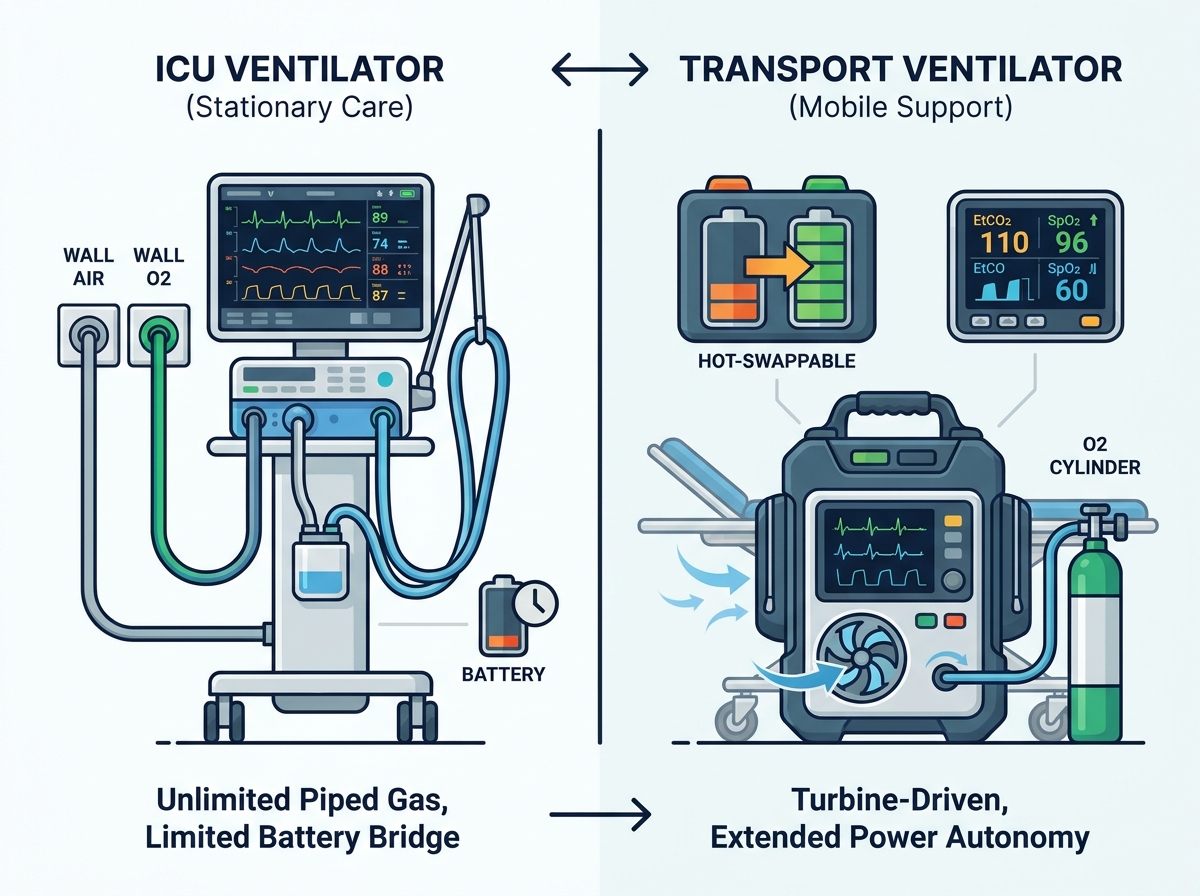
Pneumatic Independence: A dedicated ICU ventilator relies on wall-piped gas at 50 psi, whereas a portable transport ventilator utilizes turbines, internal compressors, or low-flow oxygen blending to conserve cylinder supply.
Power Redundancy: Transport units prioritize extended ventilator battery backup (often hot-swappable), while ICU models use batteries strictly as emergency bridge power.
Monitoring Tradeoffs: Advanced transport ventilators now match ICU units in core modes (PRVC, APRV) but may compromise on screen size, advanced waveform history, or metabolic monitoring to maintain durability and portability.
Total Cost of Ownership (TCO): Standardization across a hospital fleet requires analyzing consumable cross-compatibility (e.g., patient circuits) and maintenance intervals.
Understanding the fundamental differences between devices begins with analyzing their intended physical spaces. The operational environment dictates almost every engineering decision. You must define these spaces clearly before making procurement choices. This forms the basis of the transport ventilator vs ICU ventilator debate.
The standard intensive care environment offers unmatched stability. We benefit from uninterrupted electrical power. Facilities provide infinite piped medical air and oxygen. The climate remains perfectly controlled year-round. Beds experience virtually zero mechanical vibration. Therefore, manufacturers focus heavily on advanced lung mechanics. They prioritize intricate weaning tools and continuous high-fidelity monitoring. Weight and portability simply do not matter here.
Conversely, the transport environment introduces extreme hostility. Care teams face strictly finite power supplies. Gas reserves deplete constantly. Temperatures fluctuate wildly during tarmac transfers. Devices encounter significant electromagnetic interference from vehicle engines. Equipment endures severe physical shock. Helicopter Emergency Medical Services (HEMS) experience particularly intense vibration. These conditions demand rugged, self-sufficient engineering.
Historically, portable units only offered basic volume-controlled modes. Modern micro-turbines and advanced microprocessors have changed this paradigm entirely. Top-tier portable devices now deliver highly sophisticated ventilation. They provide stable Positive End-Expiratory Pressure (PEEP). They ensure highly precise fractional inspired oxygen (FiO2) delivery.
This technological convergence shifts the entire purchasing conversation. We no longer ask if a portable unit has advanced modes. Instead, we question its hardware endurance. We evaluate how long it can sustain those modes under duress.
A successful procurement decision balances clinical continuity with logistical reality. Patients must not experience drops in their standard of care during transit. However, teams must maneuver the equipment easily. You should evaluate strict standard compliance, such as ISO 10651-3. Focus on unit weight, casing durability, and user interface simplicity.
Power failure during patient transit represents a catastrophic clinical event. You must scrutinize power architecture intensely. Mobile environments offer no second chances once batteries deplete.
A stationary ICU ventilator consumes exceptionally high wattage. It powers large capacitive displays. It runs demanding heated humidifiers. Complex microprocessors require constant electricity. Their internal batteries are typically rated for only 30 to 60 minutes. Manufacturers design them strictly as emergency bridges. They provide just enough energy for localized power failures or moving a bed down a hallway.
In contrast, transport units are engineered for extreme low-power consumption. They utilize high-density lithium-ion arrays. Their screens consume less energy. They ditch integrated humidifiers in favor of passive heat and moisture exchangers (HMEs).
When reviewing technical specifications, you must look beyond top-line marketing claims. Focus on these specific evaluation metrics:
True Runtime vs. Claimed Runtime: Manufacturers conduct bench tests under optimal conditions. Real-world applications look vastly different. Delivering high PEEP demands significantly more energy. Extreme cold weather severely saps battery life. Running screens at maximum brightness depletes a ventilator battery backup much faster than expected. Always plan for lower real-world endurance.
Hot-Swappable Capabilities: You must change depleted batteries without interrupting mechanical ventilation. Devices should feature dual battery bays. This allows clinicians to swap power cells mid-flight. It prevents dangerous pauses in breathing support.
Charge Cycle Degradation: Lithium-ion cells degrade naturally. Plan battery replacement schedules carefully. Calculate the expected charge cycles before holding capacity drops below 80 percent. Frequent deep discharges accelerate this degradation process.
Best Practice: Never trust a simple percentage bar for battery life. Require visible, undeniable battery-level indicators showing exact hours and minutes remaining. This prevents catastrophic power failures during unpredictable transit delays.
Gas consumption rates separate standard equipment from elite mobile life support. When you leave the hospital room, piped oxygen disappears. You rely entirely on what you carry.
The standard stationary setup relies on dual high-pressure hoses. Facilities supply oxygen and medical air directly through the wall. This infrastructure provides infinite flow at standard 50 psi. The transport reality looks completely different. You rely heavily on small, high-pressure D or E cylinders. Space limitations strictly dictate your gas capacity.
The internal drive mechanism determines how quickly you empty those precious cylinders. Devices generally fall into two categories:
Turbine and Compressor Driven: These advanced systems draw in ambient air. They require only supplemental oxygen. They blend the precise FiO2 internally using advanced valves. This design drastically reduces reliance on heavy medical air cylinders. It extends mission autonomy significantly.
Pneumatically Driven: These units use the compressed ventilator gas source as physical force. The gas pushes the breath into the patient's lungs. They offer incredible reliability due to fewer moving parts. However, they consume cylinder gas rapidly. You risk early depletion during long transfers.
Feature | Turbine-Driven Models | Pneumatically-Driven Models |
|---|---|---|
Primary Drive Force | Internal electric motor/blower | Compressed high-pressure gas |
Gas Efficiency | Extremely high (uses ambient air) | Low (uses cylinder gas for drive) |
Battery Dependency | High (motor requires constant power) | Low (relies mainly on pneumatic pressure) |
Best Use Case | Long inter-hospital transfers, HEMS | Short intra-hospital moves, MRIs |
You must evaluate cylinder duration calculations rigorously. Minute ventilation (Ve) heavily dictates oxygen usage. Patients with high respiratory demands empty tanks quickly. Furthermore, many clinicians forget bias flow. High continuous bias flow consumes oxygen rapidly even between breaths. Note the device's specific entrainment efficiency.
Common Mistake: Failing to address the risk of sudden pressure drops. When tank pressure falls below functional thresholds, FiO2 delivery drops sharply. You must set strict protocols for swapping cylinders before they reach critical minimums.
Continuous clinical assessment remains vital during movement. However, the physical interface must adapt to severe environmental constraints. You cannot easily read a massive screen inside a vibrating helicopter.
Stationary units feature massive 15-inch capacitive touchscreens. These work beautifully in controlled lighting. Mobile units require smaller, extremely rugged interfaces. Screens must remain highly shock-resistant. They need specialized high-contrast displays. Clinicians must read them easily in direct sunlight. Touchscreens often fail when wet or covered in bodily fluids. Therefore, physical dials and tactile buttons remain essential for mobile devices.
You cannot compromise on critical data streams. Certain parameters remain mandatory for safe transfers:
Continuous Waveform Capnography (EtCO2): This is non-negotiable. It verifies advanced airway placement immediately. It confirms ventilation adequacy during heavy movement. It alerts you instantly if the endotracheal tube dislodges.
Advanced Loop Graphics: Pressure-Volume and Flow-Volume loops provide deep insights. They allow immediate troubleshooting of complex issues. You can rapidly identify tube blockages. They help diagnose developing tension pneumothorax before it becomes fatal.
Alarm fatigue kills patients. Noisy environments exacerbate this problem exponentially. Ambulances feature loud sirens and road noise. Helicopters drown out nearly all subtle auditory cues. You must carefully evaluate the alarm architecture.
Look for robust 360-degree visual alarm indicators. Bright, flashing LEDs must grab attention from any angle. Adjustable auditory tones are essential. They must cut through harsh engine noise. However, they should achieve this without causing severe clinician distraction. Customizable alarm limits prevent nuisance alerts while highlighting true emergencies.
Bringing new life support devices into a hospital network requires strategic planning. You must evaluate how the new equipment integrates with your existing workflow. Isolated purchases often lead to clinical friction and training gaps.
Examine consumable cross-compatibility carefully. Ask if the portable transport ventilator can use identical patient breathing circuits. Standardizing components saves critical minutes during emergencies. Clinicians do not have to hunt for specific proprietary tubes. More importantly, avoiding circuit changes prevents lung de-recruitment. Disconnecting a severely hypoxemic patient simply to swap a plastic circuit invites profound clinical danger.
Never take marketing terms like "rugged" at face value. You must verify strict, standardized environmental compliance ratings. Look for high IPX ratings to ensure water and dust resistance. Rain and fluid spills happen frequently during transfers.
Check for MIL-STD-810G certification. This standard guarantees rigorous drop and shock testing. Devices must survive falls from stretcher height. For flight teams, demand RTCA DO-160G certification. This guarantees aeromedical electromagnetic compatibility. The device will not interfere with aircraft avionics, nor will avionics disrupt the breathing modes.
Hardware endurance extends beyond battery life. Compare the preventative maintenance intervals among different brands. Some turbine motors require costly replacement at 15,000 hours of operation. Others boast lifespans exceeding 30,000 hours. You must monitor internal oxygen sensor lifespans closely. Paramagnetic sensors generally outlast traditional galvanic oxygen cells.
Map your maximum expected transport duration carefully. Always include potential delays like traffic or weather holds. Compare this duration directly against the unit's battery and gas autonomy limits. Demand real-world trial periods before signing contracts. Have your teams operate the devices in loud, moving vehicles. Focus heavily on user interface intuitiveness under severe stress.
The choice between stationary and mobile respiratory support ultimately rests on infrastructure dependency. You must honestly evaluate the resources surrounding the patient. Making the correct procurement choice requires balancing advanced clinical features with brutal physical realities.
Follow these actionable next steps to refine your strategy:
Prioritize Autonomy for Flight Teams: Dedicated transport teams must prioritize robust power autonomy. Turbine-driven gas efficiency remains ideal for long-range missions.
Seek Hybrid Solutions for Wards: For standard use with occasional inter-departmental transfers, seek a high-end stationary unit. It should feature an extended battery bridge and seamless bed-docking capabilities.
Demand Real-World Trials: Request comprehensive hardware models from vendors. Schedule rigorous clinical simulations with your entire respiratory therapy team.
Audit Consumables: Ensure any new mobile device accepts your currently stocked patient circuits to avoid dangerous mid-transfer swap procedures.
A: While modern transport units have advanced equivalent modes, they generally cannot replace stationary units entirely. They lack the extensive pulmonary mechanics tools required for complex weaning. They feature smaller displays. Furthermore, they lack the seamless heated-humidifier integration required for weeks-long stationary care.
A: Dedicated transport units typically offer four to ten hours of runtime using hot-swappable batteries. However, this varies heavily based on specific conditions. Cold environmental temperatures, high screen brightness, and elevated minute ventilation will deplete batteries much faster than standard bench tests predict.
A: Turbine-driven ventilators remain the standard for HEMS operations. They require only a compressed oxygen source for FiO2 blending. The turbine utilizes ambient air as the primary drive mechanism. This drastically reduces the number of heavy, dangerous cylinders needed onboard the aircraft.


