
 English


Views: 0 Author: Site Editor Publish Time: 2026-11-02 Origin: Site


When a physician prescribes oxygen therapy, they usually write the dosage in "Litres Per Minute" or LPM. You might receive a prescription for exactly 2 LPM. However, when you shop for a portable device, you quickly notice they feature generic labels like "Settings 1 through 5." This creates immediate confusion for buyers. Equating a pulse-dose setting directly to continuous flow LPM is a widespread industry misconception. Assuming they mean the same thing risks clinical under-dosing and wasted investments in incompatible equipment. We need to clear this up. This article will clarify the mechanical differences between pulse-dose algorithms and continuous flow systems. You will receive a transparent framework to evaluate which medical oxygen concentrator safely meets your specific prescription requirements.
A pulse-dose "Setting of 2" does not equal 2 Litres Per Minute (LPM) of continuous oxygen. Settings are proprietary, manufacturer-specific measurements of oxygen volume (bolus size).
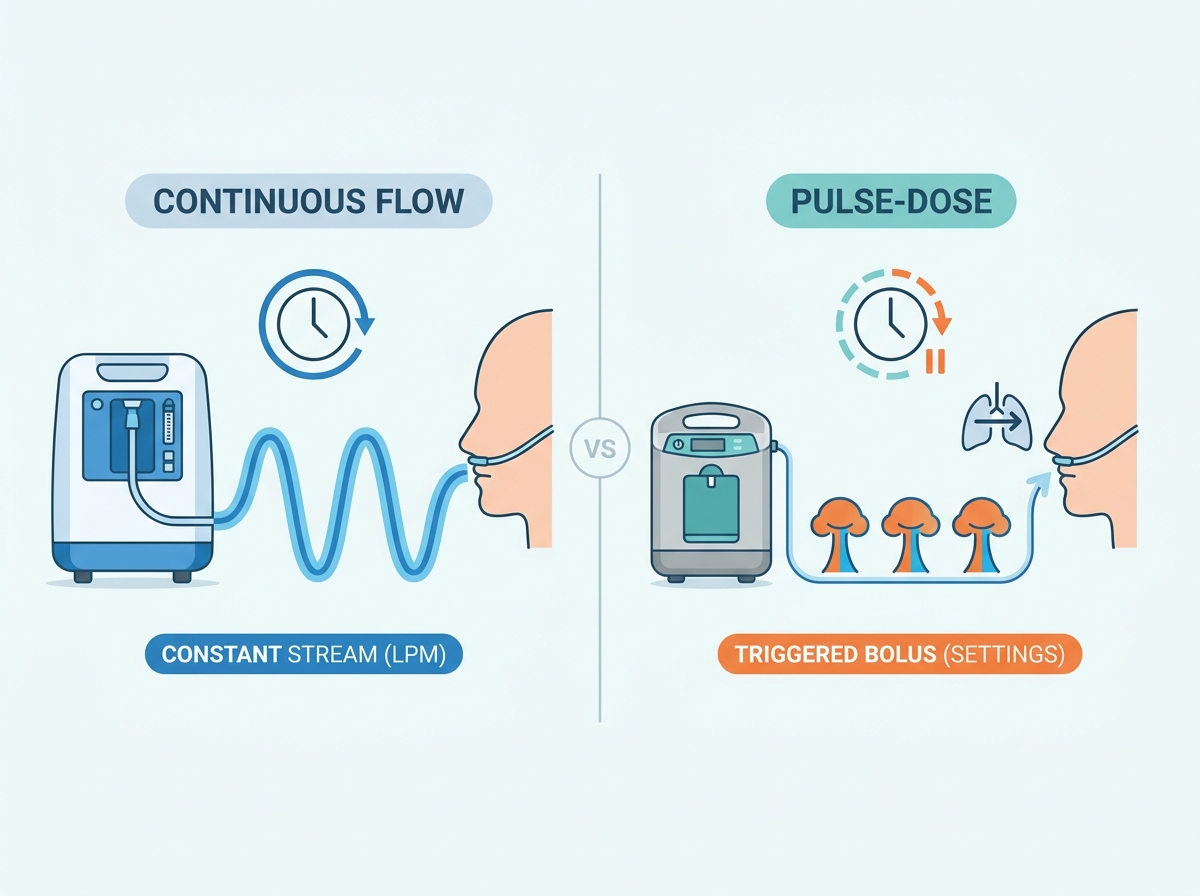
Continuous flow delivers a constant stream measured in LPM, while pulse-dose delivers "shots" of oxygen triggered only by inhalation.
Matching a continuous flow prescription to a pulse-dose machine requires medical titration to ensure proper blood oxygen saturation.
Pulse-dose efficiency significantly extends oxygen concentrator runtime, making it the standard for lightweight, portable units, but it is not universally suitable for nighttime use or sleep apnea.
Buyers frequently fall into a dangerous trap. They assume a small portable unit displaying a "Setting 5" can replace their heavy home unit delivering 5 LPM. This misunderstanding stems from a lack of standardization in how portable oxygen devices are labeled. We must break down exactly what these two measurements mean.
Litres Per Minute (LPM) is an absolute volumetric measurement. It describes a continuous flow of oxygen over exactly 60 seconds. If a machine runs at 2 LPM, it pushes out 2,000 milliliters of concentrated oxygen every minute. It does this regardless of your breathing pattern. The machine pushes oxygen whether you inhale, exhale, or pause your breath.
Conversely, numbers on a pulse-dose machine represent arbitrary settings, not absolute liters. When you see numbers 1 through 5 on a portable unit, they indicate a fixed "bolus" of oxygen. A bolus is a brief burst or shot of oxygen measured in milliliters. The machine only delivers this burst when it detects your inhalation. It stops delivering during your exhalation.
The biggest challenge for buyers is the variability factor. Every manufacturer uses different internal algorithms. Brands like Inogen, Philips, and Caire program their machines differently. A "Setting 2" on Brand A might deliver 22 milliliters per breath. A "Setting 2" on Brand B might deliver only 18 milliliters. Because these settings are proprietary, you cannot blindly equate them to an LPM prescription.
To choose the right equipment, you must understand the two primary delivery methods available in the respiratory market. Each serves an entirely different clinical purpose.
Continuous flow operates on a constant 100% duty cycle. The internal compressor runs continuously to force ambient air through the sieve beds. It then delivers a steady, unbroken stream of oxygen.
Primary Use Case: These machines excel as stationary home units. They are mandatory for sleep therapy, severe COPD cases, or patients requiring more than 3 to 4 LPM. They provide a reliable baseline of oxygen regardless of how the patient breathes.
Pulse-dose technology acts as a smart conservation system. It relies on a sensitive pressure sensor located near the cannula nozzle. When you inhale, you create negative pressure in the tubing. The sensor detects this pressure drop and instantly fires a micro-dose of oxygen.
Primary Use Case: This technology caters to ambulatory patients. It is ideal for travel, walking, and active daytime use. By only delivering oxygen when needed, it minimizes waste.
Because pulse-dose systems spend less time pumping oxygen, they vastly reduce the workload on the internal motor. This mechanical efficiency directly maximizes your oxygen concentrator runtime. It allows manufacturers to shrink the internal compressor and use much smaller, lighter battery packs. You get increased mobility at the cost of continuous delivery.
Chart: Quick Overview of Oxygen Delivery Types
Feature | Continuous Flow | Pulse-Dose |
|---|---|---|
Delivery Method | Constant stream of oxygen | Bursts triggered by inhalation |
Measurement Unit | Litres Per Minute (LPM) | Proprietary Settings (1-6) |
Device Weight | Typically heavier (15+ lbs) | Lightweight (3-6 lbs) |
Best Suited For | Sleep, severe respiratory conditions | Travel, daytime activities |
Bridging the gap between your doctor's orders and hardware specifications requires careful evaluation. You cannot simply guess your needs.
Standard medical prescriptions usually differentiate between resting states and physical exertion. A doctor might write "2 LPM at rest, 3 LPM during exertion." Your body demands more oxygen when you walk or climb stairs. Your chosen device must accommodate both physiological states.
Never attempt to self-convert an LPM prescription to a pulse setting. The math does not work linearly. Clinical titration remains the only verifiable way to match a portable setting to your prescribed LPM. During titration, a respiratory therapist monitors your blood oxygen levels using a pulse oximeter. They will ask you to sit, walk, and climb stairs while using a specific portable machine. If your blood oxygen saturation stays above 90% during these tests on Setting 3, then Setting 3 is your correct dosage for that specific machine.
It helps to understand the physical limitations of portable equipment. Even top-tier pulse units produce a maximum of 1.0 to 1.2 total liters of oxygen per minute. Their internal sieve beds simply cannot generate more pure oxygen than that. Therefore, small portable units remain physically incapable of supporting true high-flow prescriptions of 4 or 5 LPM. If your lungs require a true 4 LPM constant flow, a 5-pound machine will not keep you saturated.
Transitioning to a pulse-dose system introduces several practical constraints. Buyers must prepare for these clinical risks and daily operational realities.
You cannot have infinite battery life and a featherweight device simultaneously. Using a portable device on its highest setting drastically drains power. Buyers often read marketing brochures claiming "up to 10 hours of battery life." Manufacturers usually base these numbers on Setting 1 at a very slow breathing rate. If your titrated prescription requires Setting 4, your battery might only last two hours. Always calculate your expected runtime based on your prescribed setting, not the marketing claims.
Sleeping with a pulse-dose machine presents a critical clinical risk. During deep sleep, our breathing naturally slows and becomes shallower. Many people also naturally breathe through their mouths when they sleep. Shallow breaths or mouth breathing fail to generate enough negative pressure inside the nasal cannula. The machine's sensor will not detect your breath. It will not deliver oxygen. This scenario quickly leads to nocturnal hypoxemia. Most respiratory professionals strongly advise against using pulse-dose units for sleep.
Pulse-dose sensors require pristine conditions to function safely.
Condensation: Moisture build-up in the tubing can block the pressure sensor. You must keep the tubing dry.
Tubing Length: You cannot use long tubing. Physics dictates that pressure drops over distance. A standard 25-foot hose will diminish the suction force of your breath. The machine will fail to trigger. Always restrict pulse-dose cannula lengths to seven feet or less.
Calibration: Portable units need periodic professional calibration to ensure the breath-detection algorithm remains accurate.
Table 1: Operational Limitations of Portable Oxygen Systems
Limitation Type | Common Reality | Practical Solution |
|---|---|---|
Battery Drain | Higher settings reduce advertised battery life by up to 60%. | Purchase extended double batteries or a multi-bay charger. |
Tubing Length | Long hoses prevent the sensor from detecting inhalation. | Use only 4-foot or 7-foot nasal cannulas. |
Sleep Risk | Shallow breathing prevents the device from delivering oxygen. | Use a continuous flow stationary unit at night. |
Navigating the hardware market requires a structured approach. Use this step-by-step decision matrix to evaluate any medical oxygen concentrator before you finalize a purchase.
Clinical Clearance: Begin by consulting your pulmonologist. Verify whether a pulse-dose system is clinically acceptable for your specific respiratory profile. Not all lung diseases respond well to bolus delivery.
Capacity Buffering: Always select a device with room to grow. Avoid buying a machine where your prescribed setting is its absolute maximum limit. If you titrate at Setting 3, buy a machine that goes up to at least Setting 5. This buffer protects your investment if your disease progresses and your oxygen needs increase.
Battery Auditing: Evaluate the true cost of power. If your prescribed setting requires frequent battery swaps to maintain your necessary daily runtime, you must factor in secondary batteries. Look at the cost of external multi-bay chargers. Battery logistics often dictate the true portability of the machine.
Compliance and Trial Periods: Only purchase from retailers offering clinical trial windows. You need a few days to test the machine in real-world conditions. You must ensure the device maintains your blood oxygen saturation during daily exertion, like grocery shopping or walking the dog.
Understanding oxygen terminology protects your health and your wallet. Remember that generic "Settings" and clinical "LPM" are entirely distinct measurements. They serve completely different functional purposes in respiratory therapy. A pulse setting of 3 never guarantees 3 liters of continuous flow.
We strongly advise prioritizing medical titration over raw technical specifications. A lightweight portable device is only a viable investment if it demonstrably maintains your healthy oxygen saturation levels at its specific pulse settings. Do not guess your dosage based on brochures.
Your immediate next step should be contacting your healthcare provider. Request a dedicated "pulse-dose evaluation" to identify exactly which portable models can safely support your daily lifestyle.
A: No. CPAP and BiPAP machines deliver continuous positive airway pressure. This constant outward pressure masks the subtle negative pressure your body creates when inhaling. A pulse sensor cannot detect your breath through this pressure wall. Always use a continuous flow oxygen device for sleep apnea therapy.
A: Manufacturers calculate maximum battery life using the lowest possible setting and a slow resting breath rate. If your prescription requires a higher pulse setting, the compressor draws more power. Additionally, breathing faster during physical activity forces the machine to fire more often. Both factors severely reduce your expected runtime.
A: Usually not. A generic pulse setting of 2 indicates a specific bolus size, not 2 liters of continuous flow. Every brand uses different bolus volumes for their settings. You must undergo a clinical oximetry test to confirm if Setting 2 on a specific machine keeps your blood saturated.
A: We strongly recommend against it. Long tubing creates a large buffer of air. This diminishes the slight pressure drop needed to trigger the device's breath sensor. The machine might miss your inhalations entirely. Always restrict your nasal cannula tubing to seven feet or shorter for reliable delivery.


