
 English


Views: 0 Author: Site Editor Publish Time: 2026-11-23 Origin: Site


Buying medical equipment requires absolute precision. Facility managers and clinical buyers often mistakenly use "Patient Weight Capacity" and "Safe Working Load (SWL)" interchangeably. Treating these metrics as identical leads to dangerous under-speccing. It causes accelerated equipment failure, voided warranties, and potential patient falls. Caregiver injuries also skyrocket when bed frames buckle under unanticipated stress.
Our objective is to clarify the exact parameters of hospital bed weight ratings. We will guide your evidence-based procurement processes. You must ensure structural safety and regulatory compliance when selecting between standard and heavy-duty models. Distinguishing these limits protects your patients and your clinical staff. It also prevents premature mechanical breakdowns across your facility's entire equipment fleet. You will learn how to accurately calculate actual loads, preventing costly procurement mistakes.
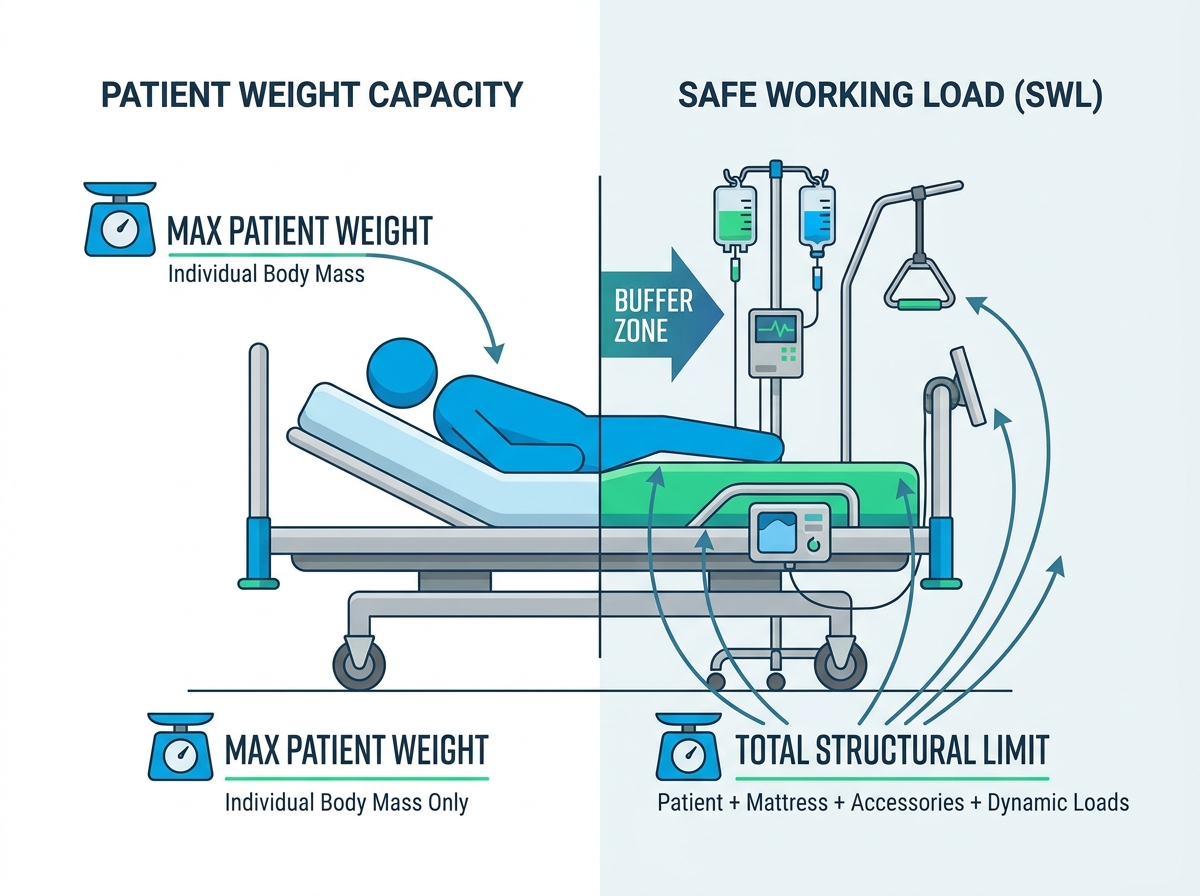
Patient Weight Capacity strictly defines the maximum safe mass of the individual occupying the bed.
Safe Working Load (SWL) is the absolute structural limit, encompassing the patient, mattress, bed rails, accessories, and temporary dynamic loads.
The Hidden Deficit: Standard hospital beds often have a 50–100 lb buffer between patient capacity and SWL, which is easily consumed by advanced therapeutic mattresses and attached medical equipment.
Decision Rule: Always calculate procurement needs based on SWL + a 20% margin of safety, rather than maximum patient weight alone.
You cannot purchase medical beds based on a single weight number. Manufacturers provide two distinct ratings. Each rating serves a completely different safety function.
The Maximum Patient Weight represents a strict clinical limit. Evaluators test this metric purely for patient safety. This number only accounts for the human body resting on the sleep surface. It completely ignores external factors. If a bed lists a patient weight capacity of 350 lbs, it means the structure safely holds a 350 lb human. It does not mean the bed holds a 350 lb human plus a heavy air mattress, oxygen tanks, and an IV pole. Buyers routinely mistake this metric for the total allowable weight. This error creates immediate safety hazards on the ward.
The Safe Working Load serves as an absolute engineering limit. This metric defines the maximum total mass the entire unit can handle. It includes the bed frame, internal actuators, and bottom castors. The equipment must safely support, articulate, and transport this total mass without structural failure. Engineering teams calculate SWL by combining the patient, all bedding, and attached medical accessories. They also factor in temporary forces. When you adjust the height or tilt the headboard, the frame must lift this combined weight. Exceeding the SWL compromises the mechanical integrity of the entire unit.
Many procurement officers fall into the buffer zone trap. A manufacturer might rate a bed for a 350 lb patient. They simultaneously assign it a 400 lb SWL. This configuration leaves only a 50 lb buffer for all other equipment. This narrow margin poses a serious problem. Acute and long-term care settings routinely exceed 50 lbs in accessories alone. Once you add a specialized therapeutic mattress, heavy linens, and vital monitoring equipment, you instantly breach the SWL. Your 350 lb patient suddenly rests on a mathematically overloaded bed. This overload accelerates metal fatigue and severely strains internal motors.
You must audit every item placed on the bed frame. The patient only represents one piece of the mathematical puzzle. Every accessory consumes a portion of your Safe Working Load.
Standard foam mattresses weigh relatively little. They usually add between 15 and 25 lbs to the frame. Advanced support surfaces tell a different story. Heavy alternating-pressure bariatric air mattresses include thick bladders and heavy internal mechanical pumps. These specialized systems easily exceed 45 lbs. If you upgrade a patient to an advanced wound care mattress, you drastically reduce your available SWL. You must account for this equipment swap during the initial procurement phase.
Bedding materials add hidden weight. Lightweight sheets barely move the needle. However, heavy fluid-proof linens add up quickly. Clinical staff also use numerous positioning aids. Foam wedges, heavy bolsters, and specialized positioning cushions accumulate mass. While a single wedge seems insignificant, multiple positioning devices consume valuable pounds. You must calculate the aggregate weight of all standard bedding protocols used in your facility.
Medical beds function as centralized care hubs. Staff attach numerous heavy accessories directly to the frame. Trapeze bars require solid steel mounting brackets. IV poles and oxygen tank holders add localized stress to specific frame joints. Orthopedic traction equipment introduces significant static weight. Even heavy-duty side rails consume SWL capacity. Every clamped accessory forces the castors and actuators to work harder. You must add the weight of every potential accessory to your total SWL calculation.
Static weight only tells half the story. You must factor in dynamic loading. Caregivers routinely lean heavily against the bed during patient transfers. Medical staff jump onto the mattress to perform emergency CPR compressions. Visitors often sit directly on the edge of the mattress. These actions introduce temporary, forceful weight spikes. A sudden 150 lb caregiver leaning on an already loaded bed can instantly breach the SWL. Engineers design SWL ratings to handle controlled movements. High-impact dynamic loads multiply effective force. You always need a generous buffer to absorb these temporary spikes.
Item Category | Specific Equipment | Estimated Weight (lbs) | Impact on SWL |
|---|---|---|---|
Support Surface | Standard Foam Mattress | 15 - 25 | Minimal drain on buffer |
Support Surface | Alternating Pressure Air Mattress (w/ Pump) | 40 - 55 | Significant drain on buffer |
Accessories | Oxygen Tank & Frame Holder | 15 - 20 | Moderate local frame stress |
Accessories | Overhead Trapeze Assembly | 20 - 30 | High upper frame stress |
Dynamic Load | Caregiver leaning during transfer | 50 - 100+ | Temporary but severe spike |
Choosing between standard and bariatric frames requires strict adherence to engineering baselines. You must establish clear procurement thresholds to ensure patient safety.
Standard medical beds share similar structural baselines across the industry. Most standard models feature an SWL ranging between 400 and 450 lbs. This baseline covers the vast majority of general admission patients. It assumes standard accessories and a moderate-weight patient. However, this 400 lb limit leaves very little room for error. When facilities equip beds for complex care, they rapidly consume this standard baseline. You must thoroughly understand your baseline before assigning beds to specific wards.
Clinical guidelines often recommend an immediate equipment upgrade for patients nearing 300 lbs. We call this the 300-lb patient rule. A patient weighing 300 lbs should automatically trigger an upgrade to a bariatric frame. Why? The math dictates it. If your patient weighs 300 lbs, and your standard SWL is 400 lbs, you only have 100 lbs remaining. A specialty air mattress (50 lbs), an IV pole (10 lbs), an oxygen tank (20 lbs), and a caregiver leaning over the rail (50 lbs) totals 130 lbs. You instantly exceed the 400 lb SWL limit. The combined weight of accessories pushes the standard frame past its failure point. Bariatric upgrades prevent this exact scenario.
Bariatric models utilize drastically different structural architecture. High-capacity beds boast SWL ratings ranging from 600 lbs to over 1000 lbs. Manufacturers engineer these frames specifically for extreme loads. They feature dual-motor articulation systems. Standard beds usually rely on a single central motor. Dual motors distribute lifting forces evenly, preventing burnout. Bariatric models also utilize reinforced steel chassis. These thicker steel beams resist bending under localized stress. They offer wider sleep decks to accommodate larger patients comfortably. Finally, they incorporate heavy-duty castors designed for extreme load distribution. These upgraded castors ensure staff can still maneuver the bed smoothly during emergencies.
Theoretical numbers on a spec sheet translate into very real mechanical behaviors on the floor. Operating equipment near its maximum limit degrades performance.
Electric beds rely on motorized linear actuators to adjust height and angles. Operating these actuators at 95% of the SWL creates severe strain. The internal motor heat increases rapidly during continuous operation. This heat degrades internal lubricants and wears down electrical contacts. You will immediately notice a drastic reduction in articulation speed. The bed will struggle to raise a heavy patient. Consistent operation at maximum capacity drastically shortens the lifespan of these expensive electronic components. You will face frequent maintenance calls and early motor replacements.
Manual units require immense physical effort when fully loaded. Evaluating a five-function manual patient bed under high weight reveals significant physical demands. Hand-crank resistance increases exponentially as you approach the SWL limit. Caregivers face severe fatigue when attempting to lift the bed. The internal gears undergo immense mechanical stress. If a caregiver forces a crank against high resistance, they risk stripping the internal gears entirely. Complex articulations like the Trendelenburg or Reverse Trendelenburg position place extreme torque on the manual mechanisms. Stripped gears instantly render the bed completely immobile, creating an emergency patient transfer situation.
Moving a fully loaded bed exposes hidden weaknesses. Castors bear the brunt of the entire SWL. When a bed operates at maximum capacity, the wheel locks face immense horizontal pressure. The risk of wheel lock failure increases exponentially. Furthermore, pushing a heavy bed across elevator thresholds or uneven flooring introduces castor shear. The sudden vertical drop forces the entire weight onto a single wheel. This shear force can snap castor stems instantly. Poor maneuverability also causes ergonomic injuries to transport staff. A heavily loaded standard frame becomes dangerously difficult to steer around tight clinical corners.
You need a standardized approach to validate equipment specifications. Follow this structured protocol to ensure you purchase the safest possible frames for your facility.
Compliance Standard Verification: You must explicitly verify regulatory compliance. Ensure the bed’s SWL rating conforms directly to IEC 60601-2-52 standards. This international standard governs medical electrical equipment and bed safety. It dictates strict testing protocols for load limits and structural integrity. Do not accept manufacturer claims without an official IEC certification certificate.
Audit Warranty Traps: Always review the fine print in manufacturer clauses. Frame warranties contain hidden traps. Manufacturers routinely void warranties if maintenance logs or incident reports indicate the SWL was breached. They will deny claims even if the patient weight limit was not exceeded. If a motor burns out and the manufacturer determines you overloaded the bed with accessories, you bear the full replacement cost.
Standardizing the Fleet: Reevaluate your baseline fleet specifications. Purchasing standard beds with a slightly higher baseline SWL dramatically improves operational readiness. For example, selecting a fleet baseline of 500 lbs instead of the standard 400 lbs offers a vital buffer. It safely accommodates borderline heavy patients plus their advanced accessories. This strategy reduces the frequency of emergency bariatric bed rentals. It streamlines your logistics and minimizes disruptive patient transfers.
Distinguishing between patient weight and Safe Working Load is not just semantics. It acts as a critical operational safeguard for your entire clinical facility. Treating these numbers interchangeably endangers patients and guarantees premature equipment failure. The Safe Working Load dictates the true physical boundaries of your medical furniture.
Buyers should immediately audit the average weight of their standard mattress systems. You must also weigh commonly attached accessories like IV poles and trapeze bars. Use these figures to establish a "true accessory baseline weight" for your specific clinical environment. Subtract this baseline from any advertised SWL before you shortlist a new bed model. Adopting this rigorous, mathematically sound approach ensures you procure durable, compliant, and undeniably safe equipment for your staff and patients.
A: It counts strictly toward the Safe Working Load. The patient weight capacity assumes a bare sleep deck. Any mattress, especially heavy alternating-pressure systems, consumes a portion of the SWL buffer. You must subtract the mattress weight from the total SWL to determine remaining capacity.
A: Immediate risks include motor stall, blown electrical fuses, or manual gear stripping. Long-term risks include micro-fractures in the steel frame and sudden castor collapse. Overloading also definitively voids manufacturer liability warranties, leaving your facility fully responsible for damages.
A: SWL is primarily a static and controlled-articulation metric. High-impact dynamic loads, like a heavy patient dropping onto the bed or a nurse performing forceful CPR, multiply the effective force. This multiplication makes maintaining a generous, conservative SWL buffer essential for daily safety.


