
 English


Views: 0 Author: Site Editor Publish Time: 2026-10-08 Origin: Site


Upgrading your digital radiography systems requires careful navigation. You must balance diagnostic accuracy against practical clinical realities. In indirect conversion systems, the scintillator material acts as the primary bottleneck. It dictates both image clarity and dose efficiency. Facilities face a challenging core dilemma today. They must choose between the established, rugged nature of Gadolinium Oxysulfide (GOS) and the premium precision of Cesium Iodide (CsI).
Choosing incorrectly can compromise diagnostic confidence or lead to premature equipment failure. This article provides clinical administrators and imaging directors with an evidence-based evaluation framework. We will help you assess which scintillator technology aligns best with your specific diagnostic requirements.
You will learn how patient demographics and operational environments dictate the right detector choice. By understanding the structural differences between these materials, you can confidently optimize both image quality and patient safety for your department.
Structural Difference Dictates Performance: GOS relies on a granular structure that inherently scatters light, slightly reducing sharpness; CsI uses a columnar (needle-like) structure that channels light directly to the photodiode, preserving spatial resolution.
Dose Efficiency (ALARA): CsI detectors offer a significantly higher Detective Quantum Efficiency (DQE), allowing for up to a 50% reduction in patient dose without sacrificing image quality—crucial for pediatric and high-volume environments.
Durability vs. Precision: While modern CsI panels are highly durable, GOS traditionally offers superior physical ruggedness and a lower replacement cost, making it viable for harsh mobile or veterinary environments.
When you integrate an X-ray flat panel detector into your workflow, the scintillator plays a vital role. Indirect conversion systems require this layer to absorb X-ray photons. The material then turns these photons into visible light. How efficiently they perform this conversion directly impacts diagnostic confidence. It also influences your daily facility throughput.
Let us look closely at the underlying physics. The detector captures incoming X-rays passing through the patient. The scintillator material absorbs these high-energy photons and emits visible light. An amorphous silicon (a-Si) photodiode array sits directly beneath this layer. This array detects the emitted light. Finally, the thin-film transistor (TFT) array converts the light into an electrical signal. Software then processes this signal into a digital image.
Light scatter presents a significant challenge during this conversion process. Lateral light spread inside the scintillator degrades the Modulation Transfer Function (MTF). MTF measures how well a system preserves image contrast at varying levels of detail. When light scatters sideways, it bleeds into adjacent pixels. This spread creates unwanted image blur. Selecting the right scintillator material is primarily about managing this lateral scatter. You want maximum light directed vertically to the photodiodes.
Best Practices for Conversion Management:
Always match your detector's scintillator type to your primary clinical application.
Regularly calibrate your detector to ensure the photodiode array accurately interprets the scintillator's specific light output.
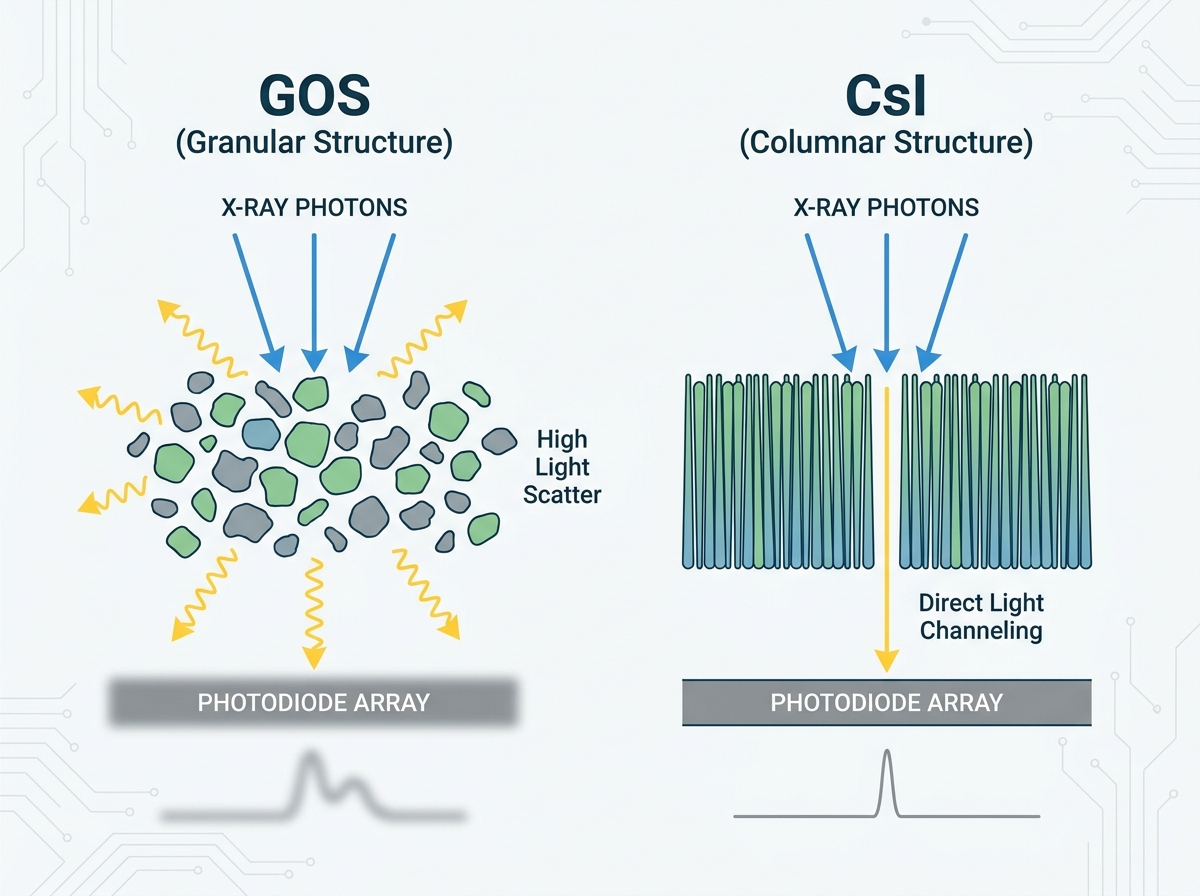
Gadolinium Oxysulfide (GOS) features a unique granular phosphor suspension. Manufacturers mix GOS phosphor particles into a resin binder. Because of this granular, unstructured nature, light emits in multiple directions upon X-ray absorption. We call this isotropic emission. The light bounces around internally before finally hitting the photodiode array.
GOS serves as a highly reliable baseline for many imaging clinics. It provides exceptional physical durability against mechanical shock and vibration. The resin binder makes the scintillator layer remarkably resilient. You can utilize these panels in fast-paced environments with less risk of catastrophic failure. They deliver excellent diagnostic yield for standard radiography. Routine chest exams, basic orthopedics, and abdominal overviews look great on GOS panels.
However, GOS has distinct technical limitations. The granular material offers a lower Detective Quantum Efficiency (DQE) compared to crystalline structures. DQE measures how efficiently a detector converts incoming X-rays into a useful image signal. A lower DQE limits your ability to reduce patient radiation doses. To absorb more X-rays and improve the signal, manufacturers must use thicker GOS scintillator layers. Unfortunately, thicker granular layers exacerbate lateral light scatter. This internal scatter inherently caps the maximum spatial resolution you can achieve. Fine micro-details often become lost in the resulting blur.
Cesium Iodide (CsI) takes a fundamentally different structural approach. Manufacturers grow CsI using a specialized vapor deposition process. This process creates a crystalline, columnar structure. These microscopic columns act exactly like fiber optics. They guide emitted light straight down to the underlying pixels.
This structured light path heavily minimizes lateral light spread. As a result, CsI delivers exceptional MTF and spatial resolution. The columnar structure allows for high X-ray absorption. Manufacturers can grow a thicker scintillator layer without suffering a severe blur penalty. You get superior DQE across various spatial frequencies. This efficiency enables strict adherence to ALARA principles (As Low As Reasonably Achievable). You can significantly reduce patient doses while maintaining sharp, diagnostic-quality images.
Historically, some imaging directors viewed CsI with heavy skepticism. Older panels suffered from severe delamination issues. Sudden temperature drops or minor physical shocks could separate the CsI layer from the photodiode. Today, modern manufacturing has largely mitigated these fragility risks. Current CsI panels feature advanced flexible substrates, such as polyimide. They withstand daily clinical rigors much better than their rigid predecessors. Shock-absorbing materials inside the casing further protect the delicate crystal columns.
You must weigh technical specifications against real-world clinical needs. We break down these evaluation dimensions into three core categories to help you decide.
We must compare quantifiable metrics to make informed decisions. A higher DQE in CsI translates directly to lower required mAs settings. You achieve the same image density and signal-to-noise ratio using fewer X-ray photons. This capability profoundly impacts complex diagnoses. When looking for micro-calcifications in mammography or fine hairline fractures in extremities, CsI provides the necessary micro-detail.
Scintillator Material Comparison Matrix
Feature | GOS (Gadolinium Oxysulfide) | CsI (Cesium Iodide) |
|---|---|---|
Structure Type | Granular phosphor in resin | Crystalline columnar (needle-like) |
Light Emission | Isotropic (scatters in all directions) | Directed (fiber-optic channeling) |
Spatial Resolution | Moderate (capped by scatter) | Excellent (preserves high MTF) |
Dose Efficiency (DQE) | Standard | High (up to 50% dose reduction) |
Physical Durability | Exceptionally robust | Highly durable (modern versions) |
Evaluate your detector necessity based on primary patient types. Specific demographics require highly tailored imaging approaches. Pediatric imaging, fluoroscopy, and bariatric imaging heavily favor CsI technology. Pediatric patients possess high dose sensitivities. Minimizing radiation exposure is paramount for children. Bariatric patients require high X-ray penetration. This often forces technologists to use higher doses. CsI helps offset these exposure risks efficiently by maximizing the signal from every captured photon.
Your detector choice also heavily affects other room components.
X-Ray Tube Preservation: Lower dose requirements mean you push less current through the X-ray tube. This creates less thermal stress on the anode.
Generator Lifespan: Less heat generation and lower power demands potentially extend the lifespan of the entire generator system.
Faster Throughput: Higher sensitivity allows for faster exposure times. Shorter exposures reduce patient motion artifacts. This limits repeat exams and speeds up overall workflow.
Deploying new detectors requires careful environmental planning. You must assess the physical risks inherent to your specific facility before choosing a scintillator material.
Assessing your drop-risk profile is an essential first step. In high-trauma mobile settings, equipment takes a severe beating. Staff move panels rapidly between hospital beds and trauma bays. The inherent ruggedness of a GOS panel might outweigh the dose benefits of CsI in these chaotic scenarios. Fixed radiography rooms pose far fewer physical risks. In a controlled room, CsI becomes a straightforward choice.
When deploying a CsI wireless DR detector, the risk of accidental drops naturally increases. Technologists no longer have heavy tethers to catch a falling panel. You must carefully evaluate the necessity of impact-resistant housings. Look for high IP68 water and dust ratings to protect against fluid ingress in emergency rooms. Always review your warranty coverage specifically for accidental drop damage before finalizing a purchase.
Scintillators respond to their surrounding climates. You should note specific temperature or humidity operating parameters for your chosen panel. Excessive humidity can degrade crystalline structures over time if the panel's protective seals fail. Cold weather presents another challenge. Moving a panel from a freezing mobile van into a warm clinic can cause internal condensation. Ensure transparent assumptions about maintenance and daily storage conditions to protect your hardware investment.
You need clear criteria to make a final decision. Let us break down the ideal use cases for each material.
When to Shortlist GOS:
Upgrading older analog rooms where strict capital constraints dictate equipment choices.
Operating busy veterinary practices or specialized equine imaging facilities.
Conducting rugged industrial Non-Destructive Testing (NDT) in harsh environments.
Managing mobile imaging fleets in nursing homes where rapid, rough handling happens daily.
When to Shortlist CsI:
Equipping main hospitals, busy orthopedic clinics, and specialized outpatient imaging centers.
Running facilities that heavily prioritize pediatric care or women's health diagnostics.
Aiming to maximize clinical reimbursement rates based on stringent image quality standards.
Future-proofing DR investments against continuously tightening radiation safety regulations.
Next-Step Actions:
Request detailed DQE curves from your potential vendors to verify performance claims.
Schedule onsite clinical demonstrations using your own standard testing phantoms.
Compare warranty terms meticulously, focusing on accidental drop protection and sensor replacement.
The choice between CsI and GOS goes beyond a simple debate of quality versus price. It requires a strategic alignment of hardware capabilities with your specific clinical use cases. The structural differences between granular and columnar materials dictate entirely different operational advantages.
While GOS remains a highly reliable workhorse for rugged or fast-paced applications, CsI stands out differently. The superior dose efficiency and micro-detail resolution of CsI make it the definitive standard for modern, patient-centric healthcare facilities. It allows clinics to adhere to ALARA principles strictly without sacrificing diagnostic confidence.
Take time to review your current exam mix carefully. Consult an imaging specialist to model the clinical impact of a CsI upgrade for your specific patient demographic. Choosing the right scintillator ensures your facility consistently delivers high-quality diagnostic care safely and effectively.
A: Not necessarily. While high DQE allows for better images at lower doses, indiscriminate use of high exposure settings narrows the visual difference between GOS and CsI. You still require proper technique and robust software processing to maximize image quality.
A: Historically, yes. However, current-generation CsI panels utilize advanced flexible substrates. Manufacturers now house them in shock-absorbing carbon-fiber enclosures. These improvements make modern panels highly resilient and suitable for demanding mobile ward environments.
A: Yes. Most flat panel detectors function as "drop-in" retrofits using Automatic Exposure Detection (AED). They sync seamlessly with existing generators without complex hardwiring. You simply adjust your technique charts to accommodate the new, lower dose settings.


