
 English


Views: 0 Author: Site Editor Publish Time: 2026-10-05 Origin: Site


Lab directors often reach a critical operational tipping point. Testing volumes rapidly outgrow existing labor capacity. This imbalance creates severe turnaround time (TAT) bottlenecks. Patient care suffers when diagnostic results face unnecessary delays. Upgrading diagnostic equipment represents more than just a simple capital expenditure. It fundamentally shifts your laboratory workflow, staff allocation, and daily throughput capacity. Managers must view this upgrade as a strategic operational transformation rather than a routine purchase.
This article provides a data-driven, objective framework for making this crucial decision. We will explore whether you should scale current operations using semi-automatic equipment. Alternatively, we will help you evaluate if transitioning to a fully automated system makes better business sense for your specific facility. You will learn how to match your current sample volume with the correct technological infrastructure.
We base this comprehensive evaluation on clear clinical accuracy standards and realistic laboratory budget constraints. Read on to discover the exact operational thresholds that trigger an intelligent equipment upgrade.
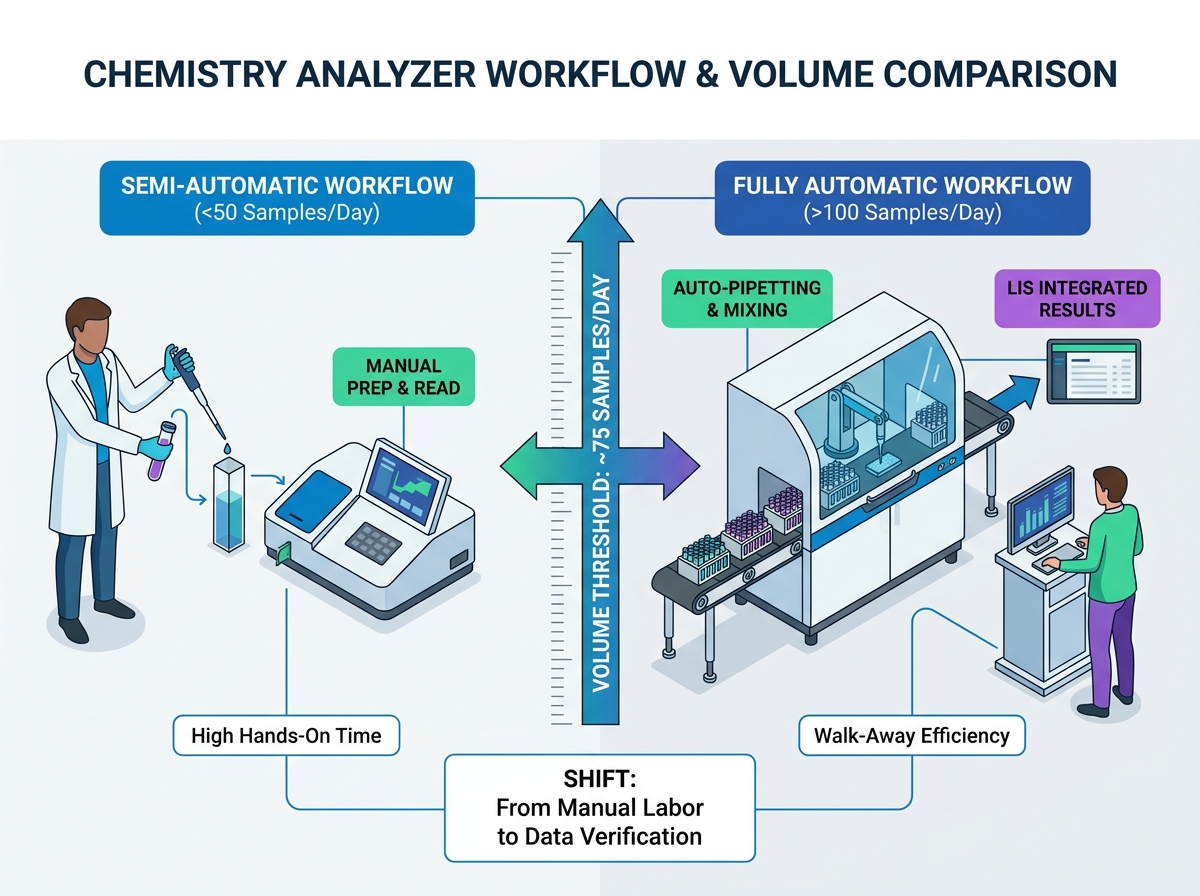
Workflow Shift: Moving from semi-automated to fully automated systems shifts staff focus from manual sample prep and pipetting to data verification and quality control.
Throughput vs. ROI: A fully automatic chemistry analyzer reduces cost-per-test at high volumes but requires a significant upfront investment and strict maintenance protocols.
Volume Thresholds: Labs processing fewer than 50-75 samples daily often maximize ROI with a semi-automatic biochemistry analyzer, whereas higher volumes necessitate the walk-away capabilities of full automation.
Hidden Costs: Automation requires robust Laboratory Information System (LIS) integration, consistent utility supply (deionized water), and specialized operator training.
Before buying new equipment, you must accurately diagnose your internal workflow constraints. Many laboratories run into severe operational walls as they grow. They simply cannot process more patient samples without aggressively adding headcount. This physical limitation directly hurts laboratory profitability and delays clinical reporting.
Every diagnostic lab must establish clear baseline goals before an upgrade. We measure operational success by evaluating three distinct targets. You achieve true workflow efficiency only when balancing all three of these metrics.
Reducing the exact cost-per-reportable-result across all testing panels.
Maintaining uncompromising clinical accuracy aligned with ISO 15189 or local standards.
Meeting strict turnaround time Service Level Agreements (SLAs) for critical patients.
Sacrificing clinical accuracy for processing speed causes disastrous compliance failures. Lowering costs by overloading your current staff inevitably leads to technician burnout.
Manual diagnostic processing carries significant hidden expenses. Technicians spend hours performing repetitive pipetting tasks. These manual steps invariably introduce human error into your daily workflow. Incubation timing variations easily skew sensitive assay results. Furthermore, repetitive strain injuries frequently plague laboratory staff over time. Such physical demands decrease overall productivity and increase medical leave requests. A high dependency on manual intervention also causes inconsistent diagnostic precision between different laboratory shifts.
Unexpected sample surges test your operational limits daily. Manual workflows struggle heavily during sudden seasonal volume spikes. Expanding your internal test menu becomes nearly impossible under these conditions. You cannot easily introduce new diagnostic assays without hiring extra Full-Time Equivalent (FTE) staff. Finding trained technicians remains incredibly difficult in today’s competitive job market. Expanding labor costs quickly erase the profit margins generated by new testing contracts.
Understanding equipment architecture helps you align technology to your specific daily needs. You must understand how hardware design dictates human interaction.
This equipment bridges the gap between purely manual testing and full robotic automation. It relies heavily on constant operator interaction to function properly.
Workflow: Technicians must perform multiple manual interventions. They handle sample preparation and precise reagent mixing manually outside the machine. The operator then presents the mixed sample to a probe for aspiration. The machine reads the absorbance and calculates the final clinical result.
Best for: This setup suits batch testing perfectly. It handles specialized low-volume assays highly efficiently. Clinics operating under constrained initial capital budgets find this operational model ideal.
A semi-automatic biochemistry analyzer offers exceptional diagnostic flexibility for smaller facilities. It allows technicians to run single STAT tests without wasting large onboard reagent volumes. However, it physically anchors your skilled staff to the laboratory bench during the entire testing process.
High-volume clinical environments demand minimal human intervention to maintain SLAs. Fully automated systems remove manual pipetting entirely from the equation.
Workflow: These systems feature continuous patient sample loading via racks or carousels. They perform automated micro-pipetting and onboard mixing autonomously. The equipment also executes stringent auto-washing cycles between tests to prevent carryover.
Best for: High-throughput environments absolutely require this advanced technology. It delivers essential walk-away time for extremely busy staff. You achieve highly standardized reporting results across broad, complex assay menus.
Deploying a fully automatic chemistry analyzer drastically transforms the laboratory floor dynamic. Technicians load barcoded samples and walk away immediately. They redirect their valuable expertise toward reviewing abnormal clinical results and managing quality control metrics.
Comparing technical features directly against clinical outcomes clarifies the entire decision process. You must look beyond simple specifications.
Evaluate hardware performance using standard Tests Per Hour (TPH). Semi-automated units might comfortably process 30 to 50 TPH. Fully automated floor models can easily exceed 800 TPH. High throughput alone does not tell the whole operational story. "Walk-away" capability drastically changes daily laboratory operations. It immediately reallocates skilled technicians to high-value intellectual tasks. They spend time investigating abnormal result flags. They monitor analytical quality control trends instead of manually pipetting patient serum.
Capital considerations drive most major equipment procurement choices today. You must contrast the high Capital Expenditure (CAPEX) of automated systems. They demand a massive upfront financial commitment from the facility. However, they deliver significantly lower Operating Expenditure (OPEX) at scale. Reagent efficiency improves drastically through advanced micro-pipetting technology. Automated systems virtually eliminate costly manual testing errors. Conversely, semi-automated units offer a very low financial entry cost. Yet, they generate significantly higher manual labor costs per test as volume grows over time.
Supply chain flexibility matters when structuring broad assay menus. Semi-automated or mid-tier automated devices often feature open reagent systems. Open systems allow you to source generic reagents from various third-party vendors. This flexibility can drive down daily consumable costs. Fully automated devices typically utilize strictly closed reagent systems. Closed systems lock you into the original manufacturer's specific reagent line. This vendor lock-in ensures exceptional analytical reliability and seamless barcode reading. It prevents mismatched lots but generally removes competitive reagent pricing options.
Clinical reliability remains your absolute highest priority. Full automation physically removes dangerous inter-operator variability. Two different technicians running the same assay will get identically precise results. The robotic arms pipette exact micro-liter volumes every single time. This mechanical consistency ensures a much tighter Coefficient of Variation (CV). You maintain better analytical stability on calibration curves and daily quality controls. It completely standardizes the clinical reporting process across all lab shifts.
Upgrading your analytical infrastructure brings distinct logistical challenges. Careful preparation prevents costly hardware installation delays.
Many managers unfortunately overlook the physical realities of fully automatic setups. These machines demand a substantial laboratory footprint with proper rear clearance. They require dedicated electrical power circuits to prevent sudden voltage drops. Most importantly, they need continuous utility fluid connections. Floor models consume significant volumes of deionized water daily for cuvette washing. You must evaluate your Clinical Laboratory Reagent Water (CLRW) capacity early. Ignoring these physical facility constraints will indefinitely stall your implementation.
Data flows must keep up with advanced hardware speeds. Bidirectional LIS connectivity becomes an absolute necessity for full automation. You cannot manually type hundreds of diagnostic results without making transcription errors. Bidirectional interfaces pull patient demographics and push verified results automatically. However, connecting medical devices to internal networks triggers strict cybersecurity concerns. IT departments must perform rigorous HIPAA or GDPR compliance checks. They must meticulously secure data ports against potential unauthorized external access.
Automation drastically reduces manual testing but increases general hardware complexity. You essentially trade pipetting time for scheduled maintenance time. Fully automated systems require intricate daily, weekly, and monthly maintenance procedures. Technicians must routinely clean probes, check syringe seals, and flush internal fluidics. These systems also require much stricter and frequent calibration schedules. A minor mechanical failure in the robotic arm can temporarily halt your entire chemistry department.
Analyzer Infrastructure Requirements Comparison
Requirement Category | Semi-Automated Systems | Fully Automated Systems |
|---|---|---|
Space & Footprint | Benchtop, minimal clearance needed | Large floor space, rear clearance required |
Water Supply | Manual fill, extremely low daily volume | Plumbed CLRW direct feed, high daily volume |
IT Connectivity | Optional, often unidirectional only | Mandatory bidirectional LIS interface |
Power Supply | Standard laboratory wall outlet | Dedicated circuit, often requires UPS backup |
We simplify the complex selection process using two common laboratory scenarios. Review these profiles to guide your purchasing decision.
Criteria: You process fewer than 50 patient samples per day. The lab space feels cramped and restricted. Budget constraints tightly restrict any new major equipment purchases.
Recommendation: A semi-automatic biochemistry analyzer perfectly matches this particular environment. It provides highly necessary diagnostic capabilities without wasting excess testing capacity. You preserve vital financial capital while maintaining reliable patient care standards. It easily handles essential diagnostic panels without demanding complex water infrastructure.
Criteria: You process well over 100 patient samples per day. Clinicians frequently complain about frustrating TAT delays. Rising technician overtime costs continuously consume your departmental budget.
Recommendation: You must procure a benchtop or floor-standing fully automatic chemistry analyzer. It becomes absolutely essential to stabilize volatile labor costs. This investment directly supports regional business growth and broad test menu expansion. Robotic walk-away processing entirely eliminates the structural bottlenecks causing your TAT failures.
Start by formally auditing your current daily testing volumes. Calculate the exact labor hours your team wastes on manual sample prep. Request detailed cost-per-test calculators from multiple equipment vendors. Compare the initial setup costs against the long-term consumable expenses. Engage your facilities manager early to verify electrical panel and water capacities.
Choosing between semi-automated and fully automated platforms defines your operational future. This specific decision fundamentally forces a choice between two distinct paths. You either prioritize immediate capital preservation or you commit to long-term scalability. A semi-automated approach protects your immediate budget while keeping labor highly manual. Conversely, full automation demands heavy initial capital but creates superior long-term labor efficiency.
Automation deeply standardizes patient results and allows rapid testing volume expansion. We strongly encourage lab managers to request physical demonstrations of these units. Consult directly with a specialized technical representative to conduct a thorough workflow audit. Download comprehensive vendor comparison matrices to map out your specific assay requirements before purchasing.
A: A realistic baseline sits around 75 to 100 tests daily. This threshold varies slightly depending on your specific test menu. Local labor costs also heavily influence the exact operational break-even point. When technician overtime surpasses the monthly equipment lease cost, automation becomes completely mandatory.
A: Yes, they can achieve equivalent clinical accuracy. Both systems frequently utilize identical photometric measuring technology. The clinical variance usually stems from poor operator technique. Manual pipetting precision differs between technicians, whereas robotics guarantee exact fluid volume delivery every single time.
A: You should expect a realistic transition timeline of roughly six weeks. This includes one to two weeks of dedicated vendor training. Following this, plan for at least 30 days of supervised LIS integration testing. This period allows staff to fully adjust to the new workflow.
A: Yes, most high-throughput floor models require specialized laboratory plumbing. They need a continuous direct feed of Clinical Laboratory Reagent Water (CLRW). High-volume wash cycles consume massive amounts of deionized water daily. You must consider this critical facility requirement before finalizing your installation plans.


