
 English


Views: 0 Author: Site Editor Publish Time: 2026-10-12 Origin: Site


Hospital procurement teams and clinical engineers face a crowded market of neonatal jaundice treatment devices. Spec sheets often feature highly technical metrics. This makes accurate comparisons incredibly difficult. Equating visible brightness with therapeutic power is a common procurement mistake. It is also a dangerous one. Relying on the wrong optical metric can result in under-dosing infants. This extends hospital stays and risks severe neurological complications.
Our goal is to equip decision-makers to cut through misleading marketing claims. You will learn to correctly interpret optical specifications. We also guide you to select evidence-based equipment. Proper selection aligns perfectly with established clinical guidelines. By understanding the science behind the light, you can ensure optimal patient safety. You will streamline your evaluation process. Ultimately, you will provide clinical teams with the exact tools they need for rapid, effective jaundice treatment.
Illuminance (Lux) is clinically irrelevant: It measures visible brightness to the human eye, not the specific blue-light wavelengths required to degrade bilirubin.
Spectral Irradiance (μW/cm²/nm) dictates efficacy: This is the only metric that measures the therapeutic dosage of blue light penetrating the infant's skin.
AAP Guidelines set the baseline: Intensive phototherapy requires a spectral irradiance of at least 30 μW/cm²/nm centered in the 430–490 nm bandwidth.
Surface area matters as much as peak power: A high irradiance reading is useless if the effective footprint cannot cover the majority of the infant's body surface area (BSA).
Procuring medical equipment requires a clear understanding of clinical success criteria. For neonatal jaundice, success means achieving rapid serum bilirubin reduction. It also requires maximizing device longevity and ensuring continuous patient safety. Misinterpreting specification sheets directly threatens these goals.
Many manufacturers highlight high "Illuminance" or "Lux" in their marketing materials. This creates a dangerous marketing trap. High Lux makes a device seem incredibly powerful to the untrained eye. However, this metric masks subpar therapeutic output. Bright light does not equal effective treatment. Falling for this trap leads to the acquisition of ineffective devices.
The clinical consequences of under-dosing an infant are severe. Using devices lacking adequate irradiance leads directly to treatment failure. Bilirubin levels may continue to rise. This potential failure introduces the requirement for high-risk exchange transfusions. It also causes extended NICU stays. Longer stays directly impact hospital operational efficiency. They strain available beds and staff resources.
Relying solely on vendor summary brochures instead of technical engineering data.
Prioritizing the visible brightness of the light source over specific wavelength data.
Failing to consult clinical engineering teams during the technical review phase.
Decision-makers must align procurement rubrics with strict clinical evidence. Avoid devices boasting only about visual brightness. Demand comprehensive data detailing actual therapeutic power.
Understanding the difference between photometry and radiometry is vital. These two branches of optical science measure light differently. Conflating them leads to poor equipment choices.
Illuminance uses the Lux unit. It is a photometric measure. Lux describes how the human eye perceives light intensity. The human eye is most sensitive to the green-yellow spectrum. This peaks at approximately 555 nanometers. Bilirubin does not respond to green-yellow light. Therefore, Lux is fundamentally useless for evaluating bilirubin isomerization. It measures room lighting, not medical treatment.
Spectral irradiance is entirely different. It is a radiometric measure. It calculates the actual electromagnetic radiation power per unit area. It also factors in the specific nanometer of the wavelength. The unit is microwatts per square centimeter per nanometer (μW/cm²/nm). This metric precisely tracks the physical energy striking the patient's skin.
When evaluating options, decision-makers must entirely discount "Lux" ratings. They are a distraction. Instead, you must demand third-party verified spectral irradiance mapping. This mapping must strictly fall within the 430–490 nm range. Any measurement outside this bandwidth wastes energy.
Optical Metrics Comparison
Metric | Unit of Measurement | Primary Application | Relevance to Phototherapy |
|---|---|---|---|
Illuminance | Lux (lx) | Human visual perception, room lighting | Irrelevant and misleading |
Spectral Irradiance | μW/cm²/nm | Therapeutic energy delivered to skin | Critical for evaluating efficacy |
Wavelength Peak | Nanometers (nm) | Targeting specific chemical reactions | Must be exactly 430–490 nm |
Clinical engineers should standardise their review process around spectral irradiance. By doing so, they eliminate ineffective devices immediately.
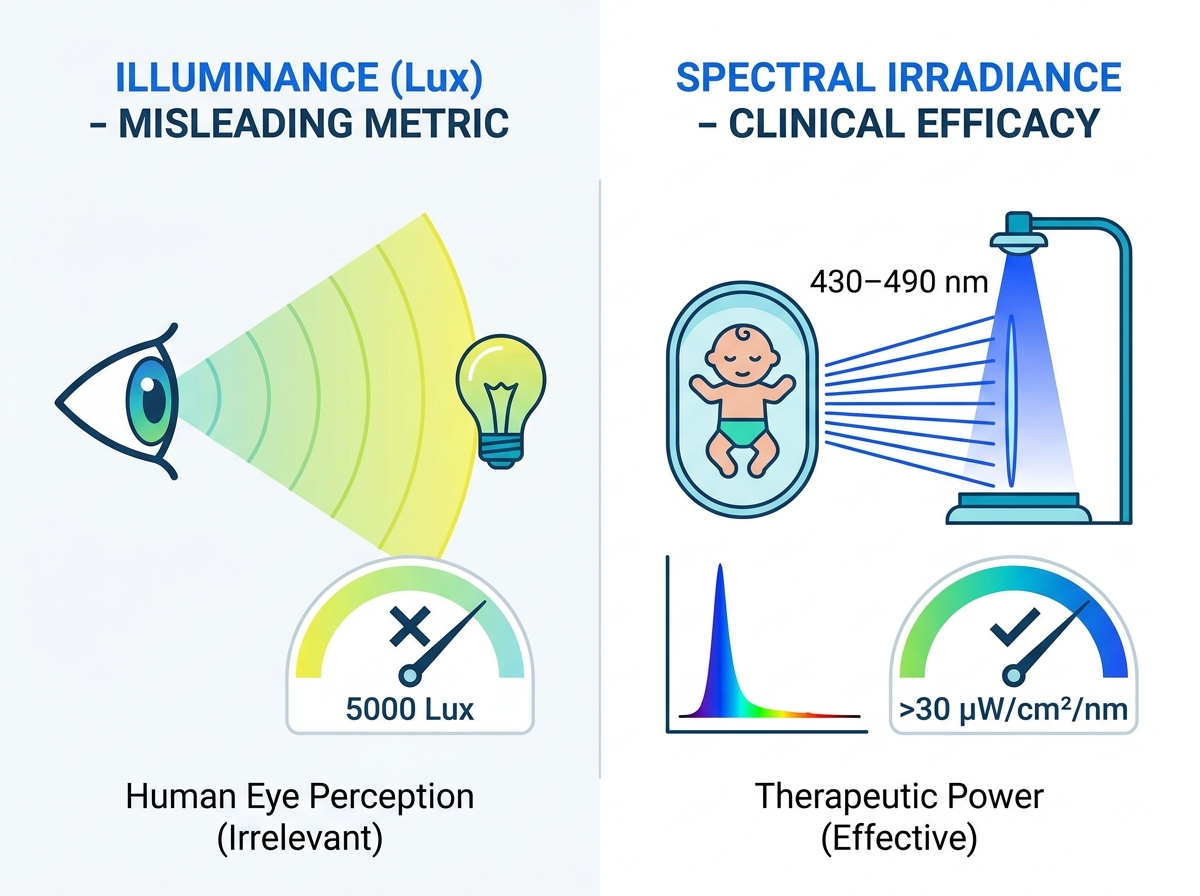
Every clinical facility must adhere to evidence-based standards. According to the American Academy of Pediatrics (AAP), "intensive phototherapy" has a strict definition. It requires a baseline expectation of at least 30 μW/cm²/nm. Any device falling below this threshold provides suboptimal care.
Evaluating an infant phototherapy unit requires analyzing the bandwidth requirement. Therapeutic light must be narrowly focused. The ideal range is between 430 and 490 nm. This is the peak absorption band for bilirubin. Broader spectrums waste energy. More dangerously, broad spectrums increase the risk of collateral skin heating.
Center versus periphery drop-off is a critical evaluation factor. Skeptical evaluation requires asking manufacturers for an irradiance footprint map. A single peak number on a spec sheet is insufficient. Many units hit 30 μW/cm²/nm only at the absolute center. The irradiance often drops well below therapeutic levels at the infant's extremities. If the footprint cannot cover the maximum body surface area, treatment slows down significantly.
Distance Variables: Irradiance must be achievable at a clinically safe distance. This is typically 30–50 cm depending on the device type.
Mattress Coverage: The therapeutic light should encompass the standard dimensions of a neonatal bassinet.
Uniformity Ratio: The ratio of center irradiance to edge irradiance should remain tight. Large drops indicate poor optical design.
Always request a physical demonstration. Use your facility's radiometer to measure the grid on the mattress. Verify the manufacturer's claims in a real-world NICU environment.
The technology driving jaundice treatment has evolved rapidly. Understanding the feature-to-outcome dimensions is vital. Moving from legacy systems to modern technology improves patient care dramatically.
Evaluating LED versus legacy halogen or fluorescent systems reveals stark differences. Modern LEDs offer a significantly narrower spectral band. They generate zero ultraviolet (UV) light. They also produce virtually zero infrared (IR) radiation. IR radiation creates unwanted heat. Eliminating heat reduces insensible water loss in the fragile infant. This protects the neonate from dehydration during prolonged therapy.
Lifespan and degradation are crucial scalability factors. High-quality LED newborn phototherapy equipment is highly durable. These devices should maintain over 80% of their initial irradiance for 20,000 to 50,000 hours. Always evaluate the manufacturer warranty against the stated LED degradation curve. Rapid degradation requires frequent bulb replacements. This compromises continuous availability.
Hospitals must consider various form factors to suit different patient needs.
Overhead Lamps: Ideal for open warmers and incubators. They provide a large footprint but require careful distance calibration.
Under-Patient Pads (Biliblankets): Excellent for maximizing body surface area. They allow for kangaroo care and parental bonding during treatment.
Bassinet Integrations: Seamless systems built into the sleeping environment.
Intensive cases often require double-surface phototherapy. This involves using both overhead and under-patient devices simultaneously. Ensure your chosen form factors offer compatible structural integration. They must provide overlapping irradiance fields. Importantly, they must do so without blocking vital clinical access to the patient.
Transitioning to new equipment introduces implementation risks. Proper shortlisting logic mitigates these hazards. Clinical engineering teams play a pivotal role here.
Radiometer compatibility is a massive implementation risk. Your clinical engineering team must use a specifically calibrated radiometer. It must match the exact bandwidth of the shortlisted LED devices. Mismatched radiometers yield false readings. Using a broad-spectrum meter on a narrow-band LED will show an artificially low output. This creates dangerous compliance gaps and user confusion.
Regulatory and security compliance cannot be overlooked. Insist on rigorous certifications. Look for FDA 510(k) clearance or CE MDR certification. These certifications must explicitly cover neonatal phototherapy. Do not accept general medical illumination clearances. The standards for direct infant treatment are fundamentally stricter.
Consider the maintenance rollout lessons from other facilities. Shortlist vendors that provide clear, standardized testing protocols. Look for easy-to-replace modular LED arrays. You want to avoid requiring full-unit replacements when individual bulbs eventually degrade. Modular designs maximize equipment uptime.
Request physical demo units for clinical engineering evaluation.
Demand independent spectroradiometer testing data directly from the manufacturer.
Perform in-house irradiance mapping at the mattress level.
Audit existing hospital radiometers to confirm bandwidth compatibility.
Bulk procurement should only happen after these steps are complete. Protect your facility by prioritizing empirical testing over glossy brochures.
Evaluating neonatal jaundice treatment equipment demands a highly scientific approach. Proper evaluation hinges on completely discarding illuminance as a metric. You must focus entirely on spectral irradiance, effective treatment footprint, and wavelength accuracy. Understanding the difference between photometric and radiometric measurements protects your patients.
We strongly recommend aligning all procurement rubrics strictly with AAP technical guidelines. Demand a minimum of 30 μW/cm²/nm in the 430–490 nm band. Verify center-to-edge drop-off mapping. Finally, always verify lifecycle maintenance requirements and radiometer compatibility with clinical engineering. Completing these checks before finalizing a purchase ensures maximum safety and clinical efficacy for your most vulnerable patients.
A: Intensive phototherapy requires a minimum spectral irradiance of greater than 30 μW/cm²/nm. This energy must be concentrated strictly within the 430–490 nm wavelength band. Furthermore, this irradiance must be applied to the maximum possible body surface area of the infant to be clinically effective.
A: This is usually due to a radiometer spectral response mismatch. Older radiometers calibrated for halogen or fluorescent broad-spectrum lights cannot accurately read narrow-band LEDs. You must use a device-specific radiometer or a broad-spectrum meter calibrated specifically for modern neonatal LED wavelengths.
A: No. Bilirubin degradation plateaus at higher levels. Pushing irradiance excessively high offers diminishing returns. It may also introduce safety risks like mild skin erythema. Maximizing the body surface area exposed to the light is clinically superior to pushing peak irradiance indefinitely higher.
A: Emphatic no. Illuminance meters measure visible brightness tailored to human eye perception (peaking at green-yellow wavelengths). They do not measure therapeutic radiometric power in the blue spectrum. Using a Lux meter creates a severe risk of false compliance and under-dosing.


